App
App
Section I
The Sovereign Pontiff
The gift of the ministry is one of the greatest gifts which Christ has bestowed upon the world. It is in reference to this that the Psalmist, predicting the ascension of Christ, thus loftily speaks of its blessed results:
"Thou hast ascended up on high: Thou hast led captivity captive; Thou hast received gifts for men, even for the rebellious, that the Lord God might dwell among them" (Eph 4:8-11).
The Church of Rome, at its first planting, had the divinely bestowed gift of a Scriptural ministry and government; and then "its faith was spoken of throughout the whole world"; its works of righteousness were both rich and abundant. But, in an evil hour, the Babylonian element was admitted into its ministry, and thenceforth, that which had been intended as a blessing, was converted into a curse. Since then, instead of sanctifying men, it has only been the means of demoralising them, and making them "twofold more the children of hell" than they would have been had they been left simply to themselves.
If there be any who imagine that there is some occult and mysterious virtue in an apostolic succession that comes through the Papacy, let them seriously consider the real character of the Pope's own orders, and of those of his bishops and clergy. From the Pope downwards, all can be shown to be now radically Babylonian. The College of Cardinals, with the Pope at its head, is just the counterpart of the Pagan College of Pontiffs, with its "Pontifex Maximus," or "Sovereign Pontiff," which had existed in Rome from the earliest times, and which is known to have been framed on the model of the grand original Council of Pontiffs at Babylon. The Pope now pretends to supremacy in the Church as the successor of Peter, to whom it is alleged that our Lord exclusively committed the keys of the kingdom of heaven. But here is the important fact that, till the Pope was invested with the title, which for a thousand years had had attached to it the power of the keys of Janus and Cybele, * no such claim to pre-eminence, or anything approaching to it, was ever publicly made on his part, on the ground of his being the possessor of the keys bestowed on Peter.
* It was only in the second century before the Christian era that the worship of Cybele, under that name, was introduced into Rome; but the same goddess, under the name of Cardea, with the "power of the key," was worshipped in Rome, along with Janus, ages before. OVID's Fasti
Very early, indeed, did the bishop of Rome show a proud and ambitious spirit; but, for the first three centuries, their claim for superior honour was founded simply on the dignity of their see, as being that of the imperial city, the capital of the Roman world. When, however, the seat of empire was removed to the East, and Constantinople threatened to eclipse Rome, some new ground for maintaining the dignity of the Bishop of Rome must be sought. That new ground was found, when, about 378, the Pope fell heir to the keys that were the symbols of two well-known Pagan divinities at Rome. Janus bore a key, and Cybele bore a key; and these are the two keys that the Pope emblazons on his arms as the ensigns of his spiritual authority. How the Pope came to be regarded as wielding the power of these keys will appear in the sequel; but that he did, in the popular apprehension, become entitled to that power at the period referred to is certain. Now, when he had come, in the estimation of the Pagans, to occupy the place of the representatives of Janus and Cybele, and therefore to be entitled to bear their keys, the Pope saw that if he could only get it believed among the Christians that Peter alone had the power of the keys, and that he was Peter's successor, then the sight of these keys would keep up the delusion, and thus, though the temporal dignity of Rome as a city should decay, his own dignity as the Bishop of Rome would be more firmly established than ever. On this policy it is evident he acted. Some time was allowed to pass away, and then, when the secret working of the Mystery of iniquity had prepared the way for it, for the first time did the Pope publicly assert his pre-eminence, as founded on the keys given to Peter. About 378 was he raised to the position which gave him, in Pagan estimation, the power of the keys referred to. In 432, and not before, did he publicly lay claim to the possession of Peter's keys. This, surely, is a striking coincidence. Does the reader ask how it was possible that men could give credit to such a baseless assumption? The words of Scripture, in regard to this very subject, give a very solemn but satisfactory answer (2 Thess 2:10,11):
"Because they received not the love of the truth, that they might be saved...For this cause God shall send them strong delusion, that they should believe a lie."
Few lies could be more gross; but, in course of time, it came to be widely believed; and now, as the statue of Jupiter is worshipped at Rome as the veritable image of Peter, so the keys of Janus and Cybele have for ages been devoutly believed to represent the keys of the same apostle.
While nothing but judicial infatuation can account for the credulity of the Christians in regarding these keys as emblems of an exclusive power given by Christ to the Pope through Peter, it is not difficult to see how the Pagans would rally round the Pope all the more readily when they heard him found his power on the possession of Peter's keys. The keys that the Pope bore were the keys of a "Peter" well known to the Pagans initiated in the Chaldean Mysteries. That Peter the apostle was ever Bishop of Rome has been proved again and again to be an arrant fable. That he ever even set foot in Rome is at the best highly doubtful. His visit to that city rests on no better authority than that of a writer at the end of the second century or beginning of the third--viz., the author of the work called The Clementines, who gravely tells us that on the occasion of his visit, finding Simon Magus there, the apostle challenged him to give proof of his miraculous or magical powers, whereupon the sorcerer flew up into the air, and Peter brought him down in such hast that his leg was broken. All historians of repute have at once rejected this story of the apostolic encounter with the magician as being destitute of all contemporary evidence; but as the visit of Peter to Rome rests on the same authority, it must stand or fall along with it, or, at least, it must be admitted to be extremely doubtful. But, while this is the case with Peter the Christian, it can be shown to be by no means doubtful that before the Christian era, and downwards, there was a "Peter" at Rome, who occupied the highest place in the Pagan priesthood. The priest who explained the Mysteries to the initiated was sometimes called by a Greek term, the Hierophant; but in primitive Chaldee, the real language of the Mysteries, his title, as pronounced without the points, was "Peter"--i.e., "the interpreter." As the revealer of that which was hidden, nothing was more natural than that, while opening up the esoteric doctrine of the Mysteries, he should be decorated with the keys of the two divinities whose mysteries he unfolded. *
* The Turkish Mufties, or "interpreters" of the Koran, derive that name from the very same verb as that from which comes Miftah, a key.
Thus we may see how the keys of Janus and Cybele would come to be known as the keys of Peter, the "interpreter" of the Mysteries. Yea, we have the strongest evidence that, in countries far removed from one another, and far distant from Rome, these keys were known by initiated Pagans not merely as the "keys of Peter," but as the keys of a Peter identified with Rome. In the Eleusinian Mysteries at Athens, when the candidates for initiation were instructed in the secret doctrine of Paganism, the explanation of that doctrine was read to them out of a book called by ordinary writers the "Book Petroma"; that is, as we are told, a book formed of stone. But this is evidently just a play upon words, according to the usual spirit of Paganism, intended to amuse the vulgar. The nature of the case, and the history of the Mysteries, alike show that this book could be none other than the "Book Pet-Roma"; that is, the "Book of the Grand Interpreter," in other words, of Hermes Trismegistus, the great "Interpreter of the Gods." In Egypt, from which Athens derived its religion, the books of Hermes were regarded as the divine fountain of all true knowledge of the Mysteries. * In Egypt, therefore, Hermes was looked up to in this very character of Grand Interpreter, or "Peter-Roma." ** In Athens, Hermes, as its well known, occupied precisely the same place, *** and, of course, in the sacred language, must have been known by the same title.
* The following are the authorities for the statement in the text: "Jamblichus says that Hermes [i.e., the Egyptian] was the god of all celestial knowledge, which, being communicated by him to his priests, authorised them to inscribe their commentaries with the name of Hermes" (WILKINSON). Again, according to the fabulous accounts of the Egyptian Mercury, he was reported...to have taught men the proper mode of approaching the Deity with prayers and sacrifice (WILKINSON). Hermes Trismegistus seems to have been regarded as a new incarnation of Thoth, and possessed of higher honours. The principal books of this Hermes, according to Clemens of Alexandria, were treated by the Egyptians with the most profound respect, and carried in their religious processions (CLEM., ALEX., Strom.).** In Egypt, "Petr" was used in this very sense. See BUNSEN, Hieroglyph, where Ptr is said to signify "to show." The interpreter was called Hierophantes, which has the very idea of "showing" in it.
*** The Athenian or Grecian Hermes is celebrated as "The source of invention...He bestows, too, mathesis on souls, by unfolding the will of the father of Jupiter, and this he accomplishes as the angel or messenger of Jupiter...He is the guardian of disciplines, because the invention of geometry, reasoning, and language is referred to this god. He presides, therefore, over every species of erudition, leading us to an intelligible essence from this mortal abode, governing the different herds of souls" (PROCLUS in Commentary on First Alcibiades, TAYLOR'S Orphic Hymns). The Grecian Hermes was so essentially the revealer or interpreter of divine things, that Hermeneutes, an interpreter, was currently said to come from his name (HYGINUS).
The priest, therefore, that in the name of Hermes explained the Mysteries, must have been decked not only with the keys of Peter, but with the keys of "Peter-Roma." Here, then, the famous "Book of Stone" begins to appear in a new light, and not only so, but to shed new light on one of the darkest and most puzzling passages of Papal history. It has always been a matter of amazement to candid historical inquirers how it could ever have come to pass that the name of Peter should be associated with Rome in the way in which it is found from the fourth century downwards--how so many in different countries had been led to believe that Peter, who was an "apostle of the circumcision," had apostatised from his Divine commission, and become bishop of a Gentile Church, and that he should be the spiritual ruler in Rome, when no satisfactory evidence could be found for his ever having been in Rome at all. But the book of "Peter-Roma" accounts for what otherwise is entirely inexplicable. The existence of such a title was too valuable to be overlooked by the Papacy; and, according to its usual policy, it was sure, if it had the opportunity, to turn it to the account of its own aggrandisement. And that opportunity it had. When the Pope came, as he did, into intimate connection with the Pagan priesthood; when they came at last, as we shall see they did, under his control, what more natural than to seek not only to reconcile Paganism and Christianity, but to make it appear that the Pagan "Peter-Roma," with his keys, meant "Peter of Rome," and that that "Peter of Rome" was the very apostle to whom the Lord Jesus Christ gave the "keys of the kingdom of heaven"? Hence, from the mere jingle of words, persons and things essentially different were confounded; and Paganism and Christianity jumbled together, that the towering ambition of a wicked priest might be gratified; and so, to the blinded Christians of the apostacy, the Pope was the representative of Peter the apostle, while to the initiated pagans, he was only the representative of Peter, the interpreter of their well known Mysteries. Thus was the Pope the express counterpart of "Janus, the double-faced." Oh! what an emphasis of meaning in the Scriptural expression, as applied to the Papacy, "The Mystery of Iniquity"!
The reader will now be prepared to understand how it is that the Pope's Grand Council of State, which assists him in the government of the Church, comes to be called the College of Cardinals. The term Cardinal is derived from Cardo, a hinge. Janus, whose key the Pope bears, was the god of doors and hinges, and was called Patulcius, and Clusius "the opener and the shutter." This had a blasphemous meaning, for he was worshipped at Rome as the grand mediator. Whatever important business was in hand, whatever deity was to be invoked, an invocation first of all must be addressed to Janus, who was recognised as the "God of gods," in whose mysterious divinity the characters of father and son were combined, and without that no prayer could be heard--the "door of heaven" could not be opened. It was this same god whose worship prevailed so exceedingly in Asia Minor at the time when our Lord sent, by his servant John, the seven Apocalyptic messages to the churches established in that region. And, therefore, in one of these messages we find Him tacitly rebuking the profane ascription of His own peculiar dignity to that divinity, and asserting His exclusive claim to the prerogative usually attributed to His rival. Thus, Revelation 3:7
"And to the angel of the church in Philadelphia write: These things saith he that is holy, he that is true, he that hath the key of David, he that openeth, and no man shutteth; and shutteth, and no man openeth."
Now, to this Janus, as Mediator, worshipped in Asia Minor, and equally, from very early times, in Rome, belonged the government of the world; and, "all power in heaven, in earth, and the sea," according to Pagan ideas, was vested in him. In this character he was said to have "jus vertendi cardinis"--the "power of turning the hinge"--of opening the doors of heaven, or of opening or shutting the gates of peace or war upon earth. The Pope, therefore, when he set up as the High-priest of Janus, assumed also the "jus vertendi cardinis," "the power of turning the hinge,"--of opening and shutting in the blasphemous Pagan sense. Slowly and cautiously at first was this power asserted; but the foundation being laid, steadily, century after century, was the grand superstructure of priestly power erected upon it. The Pagans, who saw what strides, under Papal directions, Christianity, as professed in Rome, was making towards Paganism, were more than content to recognise the Pope as possessing this power; they gladly encouraged him to rise, step by step, to the full height of the blasphemous pretensions befitting the representative of Janus--pretensions which, as all men know, are now, by the unanimous consent of Western Apostate Christendom, recognised as inherent in the office of the Bishop of Rome. To enable the Pope, however, to rise to the full plenitude of power which he now asserts, the co-operation of others was needed. When his power increased, when his dominion extended, and especially after he became a temporal sovereign, the key of Janus became too heavy for his single hand--he needed some to share with him the power of the "hinge." Hence his privy councillors, his high functionaries of state, who were associated with him in the government of the Church and the world, got the now well known title of "Cardinals"--the priests of the "hinge." This title had been previously borne by the high officials of the Roman Emperor, who, as "Pontifex Maximus," had been himself the representative of Janus, and who delegated his powers to servants of his own. Even in the reign of Theodosius, the Christian Emperor of Rome, the title of Cardinal was borne by his Prime Minister. But now both the name and the power implied in the name have long since disappeared from all civil functionaries of temporal sovereigns; and those only who aid the Pope in wielding the key of Janus--in opening and shutting--are known by the title of Cardinals, or priests of the "hinge."
I have said that the Pope became the representative of Janus, who, it is evident, was none other than the Babylonian Messiah. If the reader only considers the blasphemous assumptions of the Papacy, he will see how exactly it has copied from its original. In the countries where the Babylonian system was most thoroughly developed, we find the Sovereign Pontiff of the Babylonian god invested with the very attributes now ascribed to the Pope. Is the Pope called "God upon earth," the "Vice-God," and "Vicar of Jesus Christ"? The King in Egypt, who was Sovereign Pontiff, * was, says Wilkinson, regarded with the highest reverence as "THE REPRESENTATIVE OF THE DIVINITY ON EARTH."
* Wilkinson shows that the king had the right of enacting laws, and of managing all the affairs of religion and the State, which proves him to have been Sovereign Pontiff.
Is the Pope "Infallible," and does the Church of Rome, in consequence, boast that it has always been "unchanged and unchangeable"? The same was the case with the Chaldean Pontiff, and the system over which he presided. The Sovereign Pontiff, says the writer just quoted, was believed to be "INCAPABLE OF ERROR," * and, in consequence, there was "the greatest respect for the sanctity of old edicts"; and hence, no doubt, also the origin of the custom that "the laws of the Medes and Persians could not be altered." Does the Pope receive the adorations of the Cardinals? The king of Babylon, as Sovereign Pontiff, was adored in like manner. **
* WILKINSON'S Egyptians. "The Infallibility" was a natural result of the popular belief in regard to the relation in which the Sovereign stood to the gods: for, says Diodorus Siculus, speaking of Egypt, the king was believed to be "a partaker of the divine nature."** From the statement of LAYARD (Nineveh and its Remains and Nineveh and Babylon), it appears that as the king of Egypt was the "Head of the religion and the state," so was the king of Assyria, which included Babylon. Then we have evidence that he was worshipped. The sacred images are represented as adoring him, which could not have been the case if his own subjects did not pay their homage in that way. Then the adoration claimed by Alexander the Great evidently came from this source. It was directly in imitation of the adoration paid to the Persian kings that he required such homage. From Xenophon we have evidence that this Persian custom came from Babylon. It was when Cyrus had entered Babylon that the Persians, for the first time, testified their homage to him by adoration; for, "before this," says Xenophon (Cyropoed), "none of the Persians had given adoration to Cyrus."
Are kings and ambassadors required to kiss the Pope's slipper? This, too, is copied from the same pattern; for, says Professor Gaussen, quoting Strabo and Herodotus, "the kings of Chaldea wore on their feet slippers which the kings they conquered used to kiss." In kind, is the Pope addressed by the title of "Your Holiness"? So also was the Pagan Pontiff of Rome. The title seems to have been common to all Pontiffs. Symmachus, the last Pagan representative of the Roman Emperor, as Sovereign Pontiff, addressing one of his colleagues or fellow-pontiffs, on a step of promotion he was about to obtain, says, "I hear that YOUR HOLINESS (sanctitatem tuam) is to be called out by the sacred letters."
Peter's keys have now been restored to their rightful owner. Peter's chair must also go along with them. That far-famed chair came from the very same quarter as the cross-keys. The very same reason that led the Pope to assume the Chaldean keys naturally led him also to take possession of the vacant chair of the Pagan Pontifex Maximus. As the Pontifex, by virtue of his office, had been the Hierophant, or Interpreter of the Mysteries, his chair of office was as well entitled to be called "Peter's" chair as the Pagan keys to be called "the keys of Peter"; and so it was called accordingly. The real pedigree of the far-famed chair of Peter will appear from the following fact: "The Romans had," says Bower, "as they thought, till the year 1662, a pregnant proof, not only of Peter's erecting their chair, but of his sitting in it himself; for, till that year, the very chair on which they believed, or would make others believe, he had sat, was shown and exposed to public adoration on the 18th of January, the festival of the said chair. But while it was cleaning, in order to set it up in some conspicuous place of the Vatican, the twelve labours of Hercules unluckily appeared on it!" and so it had to be laid aside. The partisans of the Papacy were not a little disconcerted by this discovery; but they tried to put the best face on the matter they could. "Our worship," said Giacomo Bartolini, in his Sacred Antiquities of Rome, while relating the circumstances of the discovery, "Our worship, however, was not misplaced, since it was not to the wood we paid it, but to the prince of the apostles, St. Peter," that had been supposed to sit in it. Whatever the reader may think of this apology for chair-worship, he will surely at least perceive, taking this in connection with what we have already seen, that the hoary fable of Peter's chair is fairly exploded. In modern times, Rome seems to have been rather unfortunate in regard to Peter's chair; for, even after that which bore the twelve labours of Hercules had been condemned and cast aside, as unfit to bear the light that the Reformation had poured upon the darkness of the Holy See, that which was chosen to replace it was destined to reveal still more ludicrously the barefaced impostures of the Papacy. The former chair was borrowed from the Pagans; the next appears to have been purloined from the Mussulmans; for when the French soldiers under General Bonaparte took possession of Rome in 1795, they found on the back of it, in Arabic, this well known sentence of the Koran, "There is no God but God, and Mahomet is His Prophet."
The Pope has not merely a chair to sit in; but he has a chair to be carried in, in pomp and state, on men's shoulders, when he pays a visit to St. Peter's, or any of the churches of Rome. Thus does an eye-witness describe such a pageant on the Lord's Day, in the headquarters of Papal idolatry: "The drums were heard beating without. The guns of the soldiers rung on the stone pavement of the house of God, as, at the bidding of their officer, they grounded, shouldered, and presented arms. How unlike the Sabbath--how unlike religion--how unlike the suitable preparation to receive a minister of the meek and lowly Jesus! Now, moving slowly up, between the two armed lines of soldiers, appeared a long procession of ecclesiastics, bishops, canons, and cardinals, preceding the Roman pontiff, who was borne on a gilded chair, clad in vestments resplendent as the sun. His bearers were twelve men clad in crimson, being immediately preceded by several persons carrying a cross, his mitre, his triple crown, and other insignia of his office. As he was borne along on the shoulders of men, amid the gaping crowds, his head was shaded or canopied by two immense fans, made of peacocks' feathers, which were borne by two attendants." Thus it is with the Sovereign Pontiff of Rome at this day; only that, frequently, over and above being shaded by the fan, which is just the "Mystic fan of Bacchus," his chair of state is also covered with a regular canopy.
Now, look back through the vista of three thousand years, and see how the Sovereign Pontiff of Egypt used to pay a visit to the temple of his god. "Having reached the precincts of the temple," says Wilkinson, "the guards and royal attendants selected to be the representatives of the whole army entered the courts...Military bands played the favourite airs of the country; and the numerous standards of the different regiments, the banners floating on the wind, the bright lustre of arms, the immense concourse of people, and the imposing majesty of the lofty towers of the propylaea, decked with their bright-coloured flags, streaming above the cornice, presented a scene seldom, we may say, equalled on any occasion, in any country. The most striking feature of this pompous ceremony was the brilliant cortege of the monarch, who was either borne in his chair of state by the principal officers of state, under a rich canopy, or walked on foot, overshadowed with rich flabella and fans of waving plumes." We give, as a woodcut, from Wilkinson (see figure 47), the central portion of one of his plates devoted to such an Egyptian procession, that the reader may see with his own eyes how exactly the Pagan agrees with the well-known account of the Papal ceremonial.
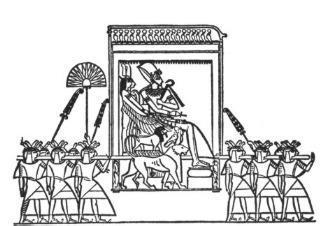 Figure 47
So much for Peter's chair and Peter's keys. Now Janus, whose key the Pope usurped with that of his wife or mother Cybele, was also Dagon. Janus, the two-headed god, "who had lived in two worlds," was the Babylonian divinity as an incarnation of Noah. Dagon, the fish-god, represented that deity as a manifestation of the same patriarch who had lived so long in the waters of the deluge. As the Pope bears the key of Janus, so he wears the mitre of Dagon. The excavations of Nineveh have put this beyond all possibility of doubt. The Papal mitre is entirely different from the mitre of Aaron and the Jewish high priests. That mitre was a turban. The two-horned mitre, which the Pope wears, when he sits on the high altar at Rome and receives the adoration of the Cardinals, is the very mitre worn by Dagon, the fish-god of the Philistines and Babylonians. There were two ways in which Dagon was anciently represented. The one was when he was depicted as half-man half-fish; the upper part being entirely human, the under part ending in the tail of a fish. The other was, when, to use the words of Layard, "the head of the fish formed a mitre above that of the man, while its scaly, fan-like tail fell as a cloak behind, leaving the human limbs and feet exposed." 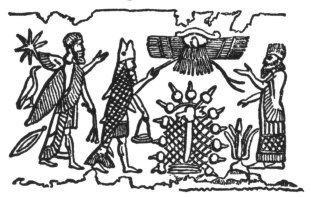 Of Dagon in this form Layard gives a representation in his last work, which is here represented to the reader (see figure 48); and no one who examines his mitre, and compares it with the Pope's as given in Elliot's Horoe, can doubt for a moment that from that, and no other source, has the pontifical mitre been derived. The gaping jaws of the fish surmounting the head of the man at Nineveh are the unmistakable counterpart of the horns of the Pope's mitre at Rome. Thus was it in the East, at least five hundred years before the Christian era. The same seems to have been the case also in Egypt; for Wilkinson, speaking of a fish of the species of Siluris, says "that one of the Genii of the Egyptian Pantheon appears under a human form, with the head of this fish."
In the West, at a later period, we have evidence that the Pagans had detached the fish-head mitre from the body of the fish, and used that mitre alone to adorn the head of the great Mediatorial god; for on several Maltese Pagan coins that god, with the well-known attributes of Osiris, is represented with nothing of the fish save the mitre on his head (see figure 49); very nearly in the same form as the mitre of the Pope, or of a Papal bishop at this day.
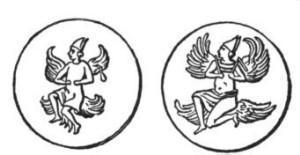 Figure 49
Even in China, the same practice of wearing the fish-head mitre had evidently once prevailed; for the very counterpart of the Papal mitre, as worn by the Chinese Emperor, has subsisted to modern times. "Is it known," asks a well-read author of the present day, in a private communication to me, "that the Emperor of China, in all ages, even to the present year, as high priest of the nation, once a year prays for and blesses the whole nation, having his priestly robes on and his mitre on his head, the same, the very same, as that worn by the Roman Pontiff for near 1200 years? Such is the fact." In proof of this statement the accompanying figure of the Imperial mitre (see figure 50) is produced - which is the very fascimile of the Popish Episcopal Mitre, in a front view. 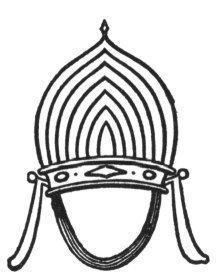 The reader must bear in mind, that even in Japan, still farther distant from Babel than China itself, one of the divinities is represented with the same symbol of might as prevailed in Assyria--even the bull's horns, and is called "The ox-headed Prince of Heaven." If the symbol of Nimrod, as Kronos, "The Horned one," is thus found in Japan, it cannot be surprising that the symbol of Dagon should be found in China.
But there is another symbol of the Pope's power which must not be overlooked, and that is the pontifical crosier. Whence came the crosier? The answer to this, in the first place, is, that the Pope stole it from the Roman augur. The classical reader may remember, that when the Roman augurs consulted the heavens, or took prognostics from the aspect of the sky, there was a certain instrument with which it was indispensable that they should be equipped. That instrument with which they described the portion of the heavens on which their observations were to be made, was curved at the one end, and was called "lituus." Now, so manifestly was the "lituus," or crooked rod of the Roman augurs, identical with the pontifical crosier, that Roman Catholic writers themselves, writing in the Dark Ages, at a time when disguise was thought unnecessary, did not hesitate to use the term "lituus" as a synonym for the crosier. Thus a Papal writer describes a certain Pope or Papal bishop as "mitra lituoque decorus," adorned with the mitre and the augur's rod, meaning thereby that he was "adorned with the mitre and the crosier." But this lituus, or divining-rod, of the Roman augurs, was, as is well known, borrowed from the Etruscans, who, again, had derived it, along with their religion, from the Assyrians. As the Roman augur was distinguished by his crooked rod, so the Chaldean soothsayers and priests, in the performance of their magic rites, were generally equipped with a crook or crosier. This magic crook can be traced up directly to the first king of Babylon, that is, Nimrod, who, as stated by Berosus, was the first that bore the title of a Shepherd-king. In Hebrew, or the Chaldee of the days of Abraham, "Nimrod the Shepherd," is just Nimrod "He-Roe"; and from this title of the "mighty hunter before the Lord," have no doubt been derived, both the name of Hero itself, and all that Hero-worship which has since overspread the world. Certain it is that Nimrod's deified successors have generally been represented with the crook or crosier. This was the case in Babylon and Nineveh, as the extant monuments show. The accompanying figure (see figure 51) from Babylon shows the crosier in its ruder guise. In Layard, it may be seen in a more ornate form, and nearly resembling the papal crosier as borne at this day. * This was the case in Egypt, after the Babylonian power was established there, as the statues of Osiris with his crosier bear witness, ** Osiris himself being frequently represented as a crosier with an eye above it.
* Nineveh and Babylon. Layard seems to think the instrument referred to, which is borne by the king, "attired as high priest in his sacrificial robes," a sickle; but any one who attentively examines it will see that it is a crosier, adorned with studs, as is commonly the case even now with the Roman crosiers, only, that instead of being held erect, it is held downwards.** The well known name Pharaoh, the title of the Pontiff-kings of Egypt, is just the Egyptian form of the Hebrew He-Roe. Pharaoh in Genesis, without the points, is "Phe-Roe." Phe is the Egyptian definite article. It was not shepherd-kings that the Egyptians abhorred, but Roi-Tzan, "shepherds of cattle" (Gen 46:34). Without the article Roe, a "shepherd," is manifestly the original of the French Roi, a king, whence the adjective royal; and from Ro, which signifies to "act the shepherd," which is frequently pronounced Reg--(with Sh, which signifies "He who is," or "who does," affixed)--comes Regah, "He who acts the shepherd," whence the Latin Rex, and Regal.
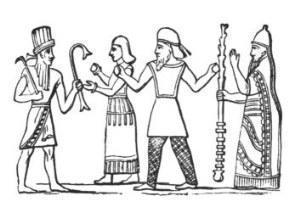 Figure 51
This is the case among the Negroes of Africa, whose god, called the Fetiche, is represented in the form of a crosier, as is evident from the following words of Hurd: "They place Fetiches before their doors, and these titular deities are made in the form of grapples or hooks, which we generally make use of to shake our fruit trees." This is the case at this hour in Thibet, where the Lamas or Theros bear, as stated by the Jesuit Huc, a crosier, as the ensign of their office. This is the case even in the far-distant Japan, where, in a description of the idols of the great temple of Miaco, the spiritual capital, we find this statement: "Their heads are adorned with rays of glory, and some of them have shepherds' crooks in their hands, pointing out that they are the guardians of mankind against all the machinations of evil spirits." The crosier of the Pope, then, which he bears as an emblem of his office, as the great shepherd of the sheep, is neither more nor less than the augur's crooked staff, or magic rod of the priests of Nimrod.
Now, what say the worshippers of the apostolic succession to all this? What think they now of their vaunted orders as derived from Peter of Rome? Surely they have much reason to be proud of them. But what, I further ask, would even the old Pagan priests say who left the stage of time while the martyrs were still battling against their gods, and, rather than symbolise with them, "loved not their lives unto the death," if they were to see the present aspect of the so-called Church of European Christendom? What would Belshazzar himself say, if it were possible for him to "revisit the glimpses of the moon," and enter St. Peter's at Rome, and see the Pope in his pontificals, in all his pomp and glory? Surely he would conclude that he had only entered one of his own well known temples, and that all things continued as they were at Babylon, on that memorable night, when he saw with astonished eyes the handwriting on the wall: "Mene, mene, tekel, Upharsin."