App
App
Section VI
The Sign of the Cross
There is yet one more symbol of the Romish worship to be noticed, and that is the sign of the cross. In the Papal system as is well known, the sign of the cross and the image of the cross are all in all. No prayer can be said, no worship engaged in, no step almost can be taken, without the frequent use of the sign of the cross. The cross is looked upon as the grand charm, as the great refuge in every season of danger, in every hour of temptation as the infallible preservative from all the powers of darkness. The cross is adored with all the homage due only to the Most High; and for any one to call it, in the hearing of a genuine Romanist, by the Scriptural term, "the accursed tree," is a mortal offence. To say that such superstitious feeling for the sign of the cross, such worship as Rome pays to a wooden or a metal cross, ever grew out of the saying of Paul, "God forbid that I should glory, save in the cross of our Lord Jesus Christ"--that is, in the doctrine of Christ crucified--is a mere absurdity, a shallow subterfuge and pretence. The magic virtues attributed to the so-called sign of the cross, the worship bestowed on it, never came from such a source. The same sign of the cross that Rome now worships was used in the Babylonian Mysteries, was applied by Paganism to the same magic purposes, was honoured with the same honours. That which is now called the Christian cross was originally no Christian emblem at all, but was the mystic Tau of the Chaldeans and Egyptians--the true original form of the letter T--the initial of the name of Tammuz--which, in Hebrew, radically the same as ancient Chaldee, as found on coins, was formed as in No. 1 of the accompanying woodcut (see figure 43); and in Etrurian and Coptic, as in Nos. 2 and 3. That mystic Tau was marked in baptism on the foreheads of those initiated in the Mysteries, * and was used in every variety of way as a most sacred symbol.
* TERTULLIAN, De Proescript. Hoeret. The language of Tertullian implies that those who were initiated by baptism in the Mysteries were marked on the forehead in the same way, as his Christian countrymen in Africa, who had begun by this time to be marked in baptism with the sign of the cross.
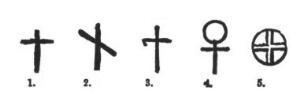 Figure 43
To identify Tammuz with the sun it was joined sometimes to the circle of the sun, as in the forth symbol of figure 43; sometimes it was inserted in the circle, as in the fifth symbol of figure 43. Whether the Maltese cross, which the Romish bishops append to their names as a symbol of their episcopal dignity, is the letter T, may be doubtful; but there seems no reason to doubt that that Maltese cross is an express symbol of the sun; for Layard found it as a sacred symbol in Nineveh in such a connection as led him to identify it with the sun. The mystic Tau, as the symbol of the great divinity, was called "the sign of life"; it was used as an amulet over the heart; it was marked on the official garments of the priests, as on the official garments of the priests of Rome; it was borne by kings in their hand, as a token of their dignity or divinely-conferred authority. The Vestal virgins of Pagan Rome wore it suspended from their necklaces, as the nuns do now. The Egyptians did the same, and many of the barbarous nations with whom they had intercourse, as the Egyptian monuments bear witness. In reference to the adorning of some of these tribes, Wilkinson thus writes: "The girdle was sometimes highly ornamented; men as well as women wore earrings; and they frequently had a small cross suspended to a necklace, or to the collar of their dress. The adoption of this last was not peculiar to them; it was also appended to, or figured upon, the robes of the Rot-n-no; and traces of it may be seen in the fancy ornaments of the Rebo, showing that it was already in use as early as the fifteenth century before the Christian era." (see figure 44 below).
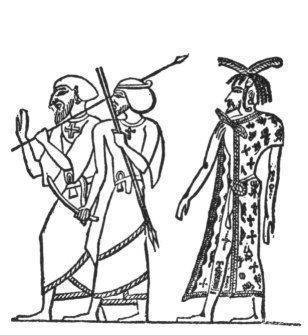 Figure 44
There is hardly a Pagan tribe where the cross has not been found. The cross was worshipped by the Pagan Celts long before the incarnation and death of Christ. "It is a fact," says Maurice, "not less remarkable than well-attested, that the Druids in their groves were accustomed to select the most stately and beautiful tree as an emblem of the Deity they adored, and having cut the side branches, they affixed two of the largest of them to the highest part of the trunk, in such a manner that those branches extended on each side like the arms of a man, and, together with the body, presented the appearance of a HUGE CROSS, and on the bark, in several places, was also inscribed the letter Thau." It was worshipped in Mexico for ages before the Roman Catholic missionaries set foot there, large stone crosses being erected, probably to the "god of rain." The cross thus widely worshipped, or regarded as a sacred emblem, was the unequivocal symbol of Bacchus, the Babylonian Messiah, for he was represented with a head-band covered with crosses (see figure 45 below).
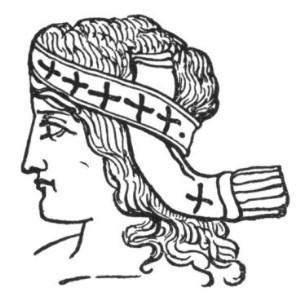 Figure 45
This symbol of the Babylonian god is reverenced at this day in all the wide wastes of Tartary, where Buddhism prevails, and the way in which it is represented among them forms a striking commentary on the language applied by Rome to the Cross. "The cross," says Colonel Wilford, in the Asiatic Researches, "though not an object of worship among the Baud'has or Buddhists, is a favourite emblem and device among them. It is exactly the cross of the Manicheans, with leaves and flowers springing from it. This cross, putting forth leaves and flowers (and fruit also, as I am told), is called the divine tree, the tree of the gods, the tree of life and knowledge, and productive of whatever is good and desirable, and is placed in the terrestrial paradise." (see figure 46). Compare this with the language of Rome applied to the cross, and it will be seen how exact is the coincidence. In the Office of the Cross, it is called the "Tree of life," and the worshippers are taught thus to address it: "Hail, O Cross, triumphal wood, true salvation of the world, among trees there is none like thee in leaf, flower, and bud...O Cross, our only hope, increase righteousness to the godly and pardon the offences of the guilty." *
* The above was actually versified by the Romanisers in the Church of England, and published along with much besides from the same source, some years ago, in a volume entitled Devotions on the Passion. The London Record, of April, 1842, gave the following as a specimen of the "Devotions" provided by these "wolves in sheep's clothing" for members of the Church of England:--"O faithful cross, thou peerless tree,
No forest yields the like of thee,
Leaf, flower, and bud;
Sweet is the wood, and sweet the weight,
And sweet the nails that penetrate
Thee, thou sweet wood."
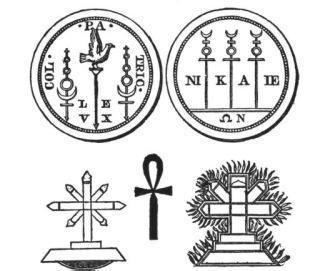 Figure 46
Can any one, reading the gospel narrative of the crucifixion, possibly believe that that narrative of itself could ever germinate into such extravagance of "leaf, flower, and bud," as thus appears in this Roman Office? But when it is considered that the Buddhist, like the Babylonian cross, was the recognised emblem of Tammuz, who was known as the mistletoe branch, or "All-heal," then it is easy to see how the sacred Initial should be represented as covered with leaves, and how Rome, in adopting it, should call it the "Medicine which preserves the healthful, heals the sick, and does what mere human power alone could never do."
Now, this Pagan symbol seems first to have crept into the Christian Church in Egypt, and generally into Africa. A statement of Tertullian, about the middle of the third century, shows how much, by that time, the Church of Carthage was infected with the old leaven. Egypt especially, which was never thoroughly evangelised, appears to have taken the lead in bringing in this Pagan symbol. The first form of that which is called the Christian Cross, found on Christian monuments there, is the unequivocal Pagan Tau, or Egyptian "Sign of life." Let the reader peruse the following statement of Sir G. Wilkinson: "A still more curious fact may be mentioned respecting this hieroglyphical character [the Tau], that the early Christians of Egypt adopted it in lieu of the cross, which was afterwards substituted for it, prefixing it to inscriptions in the same manner as the cross in later times. For, though Dr. Young had some scruples in believing the statement of Sir A. Edmonstone, that it holds that position in the sepulchres of the great Oasis, I can attest that such is the case, and that numerous inscriptions, headed by the Tau, are preserved to the present day on early Christian monuments." The drift of this statement is evidently this, that in Egypt the earliest form of that which has since been called the cross, was no other than the "Crux Ansata," or "Sign of life," borne by Osiris and all the Egyptian gods; that the ansa or "handle" was afterwards dispensed with, and that it became the simple Tau, or ordinary cross, as it appears at this day, and that the design of its first employment on the sepulchres, therefore, could have no reference to the crucifixion of the Nazarene, but was simply the result of the attachment to old and long-cherished Pagan symbols, which is always strong in those who, with the adoption of the Christian name and profession, are still, to a large extent, Pagan in heart and feeling. This, and this only, is the origin of the worship of the "cross."
This, no doubt, will appear all very strange and very incredible to those who have read Church history, as most have done to a large extent, even amongst Protestants, through Romish spectacles; and especially to those who call to mind the famous story told of the miraculous appearance of the cross to Constantine on the day before the decisive victory at the Milvian bridge, that decided the fortunes of avowed Paganism and nominal Christianity. That story, as commonly told, if true, would certainly give a Divine sanction to the reverence for the cross. But that story, when sifted to the bottom, according to the common version of it, will be found to be based on a delusion--a delusion, however, into which so good a man as Milner has allowed himself to fall. Milner's account is as follows: "Constantine, marching from France into Italy against Maxentius, in an expedition which was likely either to exalt or to ruin him, was oppressed with anxiety. Some god he thought needful to protect him; the God of the Christians he was most inclined to respect, but he wanted some satisfactory proof of His real existence and power, and he neither understood the means of acquiring this, nor could he be content with the atheistic indifference in which so many generals and heroes since his time have acquiesced. He prayed, he implored with such vehemence and importunity, and God left him not unanswered. While he was marching with his forces in the afternoon, the trophy of the cross appeared very luminous in the heavens, brighter than the sun, with this inscription, 'Conquer by this.' He and his soldiers were astonished at the sight; but he continued pondering on the event till night. And Christ appeared to him when asleep with the same sign of the cross, and directed him to make use of the symbol as his military ensign." Such is the statement of Milner.
Now, in regard to the "trophy of the cross," a few words will suffice to show that it is utterly unfounded. I do not think it necessary to dispute the fact of some miraculous sign having been given. There may, or there may not, have been on this occasion a "dignus vindice nodus," a crisis worthy of a Divine interposition. Whether, however, there was anything out of the ordinary course, I do not inquire. But this I say, on the supposition that Constantine in this matter acted in good faith, and that there actually was a miraculous appearance in the heavens, that it as not the sign of the cross that was seen, but quite a different thing, the name of Christ. That this was the case, we have at once the testimony of Lactantius, who was the tutor of Constantine's son Crispus--the earliest author who gives any account of the matter, and the indisputable evidence of the standards of Constantine themselves, as handed down to us on medals struck at the time. The testimony of Lactantius is most decisive: "Constantine was warned in a dream to make the celestial sign of God upon his solders' shields, and so to join battle. He did as he was bid, and with the transverse letter X circumflecting the head of it, he marks Christ on their shields. Equipped with this sign, his army takes the sword." Now, the letter X was just the initial of the name of Christ, being equivalent in Greek to CH. If, therefore, Constantine did as he was bid, when he made "the celestial sign of God" in the form of "the letter X," it was that "letter X," as the symbol of "Christ" and not the sign of the cross, which he saw in the heavens. When the Labarum, or far-famed standard of Constantine itself, properly so called, was made, we have the evidence of Ambrose, the well-known Bishop of Milan, that that standard was formed on the very principle contained in the statement of Lactantius--viz., simply to display the Redeemer's name. He calls it "Labarum, hoc est Christi sacratum nomine signum."--"The Labarum, that is, the ensign consecrated by the NAME of Christ." *
* Epistle of Ambrose to the Emperor Theodosius about the proposal to restore the Pagan altar of Victory in the Roman Senate. The subject of the Labarum has been much confused through ignorance of the meaning of the word. Bryant assumes (and I was myself formerly led away by the assumption) that it was applied to the standard bearing the crescent and the cross, but he produces no evidence for the assumption; and I am now satisfied that none can be produced. The name Labarum, which is generally believed to have come from the East, treated as an Oriental word, gives forth its meaning at once. It evidently comes from Lab, "to vibrate," or "move to and fro," and ar "to be active." Interpreted thus, Labarum signifies simply a banner or flag, "waving to and fro" in the wind, and this entirely agrees with the language of Ambrose "an ensign consecrated by the name of Christ," which implies a banner.
There is not the slightest allusion to any cross--to anything but the simple name of Christ. While we have these testimonies of Lactantius and Ambrose, when we come to examine the standard of Constantine, we find the accounts of both authors fully borne out; we find that that standard, bearing on it these very words, "Hoc signo victor eris," "In this sign thou shalt be a conqueror," said to have been addressed from heaven to the emperor, has nothing at all in the shape of a cross, but "the letter X." In the Roman Catacombs, on a Christian monument to "Sinphonia and her sons," there is a distinct allusion to the story of the vision; but that allusion also shows that the X, and not the cross, was regarded as the "heavenly sign." The words at the head of the inscription are these: "In Hoc Vinces [In this thou shalt overcome] X." Nothing whatever but the X is here given as the "Victorious Sign." There are some examples, no doubt, of Constantine's standard, in which there is a cross-bar, from which the flag is suspended, that contains that "letter X"; and Eusebius, who wrote when superstition and apostacy were working, tries hard to make it appear that that cross-bar was the essential element in the ensign of Constantine. But this is obviously a mistake; that cross-bar was nothing new, nothing peculiar to Constantine's standard. Tertullian shows that that cross-bar was found long before on the vexillum, the Roman Pagan standard, that carried a flag; and it was used simply for the purpose of displaying that flag.
If, therefore, that cross-bar was the "celestial sign," it needed no voice from heaven to direct Constantine to make it; nor would the making or displaying of it have excited any particular attention on the part of those who saw it. We find no evidence at all that the famous legend, "In this overcome," has any reference to this cross-bar; but we find evidence the most decisive that that legend does refer to the X. Now, that that X was not intended as the sign of the cross, but as the initial of Christ's name, is manifest from this, that the Greek P, equivalent to our R, is inserted in the middle of it, making by their union CHR. The standard of Constantine, then, was just the name of Christ. Whether the device came from earth or from heaven--whether it was suggested by human wisdom or Divine, supposing that Constantine was sincere in his Christian profession, nothing more was implied in it than a literal embodiment of the sentiment of the Psalmist, "In the name of the Lord will we display our banners." To display that name on the standards of Imperial Rome was a thing absolutely new; and the sight of that name, there can be little doubt, nerved the Christian soldiers in Constantine's army with more than usual fire to fight and conquer at the Milvian bridge.
In the above remarks I have gone on the supposition that Constantine acted in good faith as a Christian. His good faith, however, has been questioned; and I am not without my suspicions that the X may have been intended to have one meaning to the Christians and another to the Pagans. It is certain that the X was the symbol of the god Ham in Egypt, and as such was exhibited on the breast of his image. Whichever view be taken, however, of Constantine's sincerity, the supposed Divine warrant for reverencing the sign of the cross entirely falls to the ground. In regard to the X, there is no doubt that, by the Christians who knew nothing of secret plots or devices, it was generally taken, as Lactantius declares, as equivalent to the name of "Christ." In this view, therefore, it had no very great attractions for the Pagans, who, even in worshipping Horus, had always been accustomed to make use of the mystic tau or cross, as the "sign of life," or the magical charm that secured all that was good, and warded off everything that was evil. When, therefore, multitudes of the Pagans, on the conversion of Constantine, flocked into the Church, like the semi-Pagans of Egypt, they brought along with them their predilection for the old symbol. The consequence was, that in no great length of time, as apostacy proceeded, the X which in itself was not an unnatural symbol of Christ, the true Messiah, and which had once been regarded as such, was allowed to go entirely into disuse, and the Tau, the sign of the cross, the indisputable sign of Tammuz, the false Messiah, was everywhere substituted in its stead. Thus, by the "sign of the cross," Christ has been crucified anew by those who profess to be His disciples. Now, if these things be matter of historic fact, who can wonder that, in the Romish Church, "the sign of the cross" has always and everywhere been seen to be such an instrument of rank superstition and delusion?
There is more, much more, in the rites and ceremonies of Rome that might be brought to elucidate our subject. But the above may suffice. *
* If the above remarks be well founded, surely it cannot be right that this sign of the cross, or emblem of Tammuz, should be used in Christian baptism. At the period of the Revolution, a Royal Commission, appointed to inquire into the Rites and Ceremonies of the Church of England, numbering among its members eight or ten bishops, strongly recommended that the use of the cross, as tending to superstition, should be laid aside. If such a recommendation was given then, and that by such authority as members of the Church of England must respect, how much ought that recommendation to be enforced by the new light which Providence has cast on the subject!