App
App
by Dwight Blevins
with contributions from: Betty Blevins, Marlin Halverson & Cassandra Halverson
The commands of God for the Wave Sheaf as recorded in Leviticus 23 are very specific. The fulfillment of these commands is directly connected to the crossing of the Jordan River when the children of Israel began to conquer the land of Canaan also. There is a connection between these commands and the beginning of the Exodus, from the land of Egypt. Understanding these commands, how and when they were fulfilled, is the foundation for understanding how to properly count to the Feast of Pentecost. This eye-opening publication reveals the significance of their historical fulfillment for Christians today.
The offering of the wave sheaf was required by God each year before the spring harvest was reaped. This annual offering was always waved before God on the first day of the week, or "the morrow after the Sabbath." The day of the wave sheaf is significant for God's people today because it commemorates the ascension of Jesus Christ and His acceptance by the Father as the "first of the firstfruits." This epochal event was required in God's plan of salvation before the harvest of spiritual firstfruits could begin. This spiritual harvest is symbolized by the Feast of Pentecost, which will ultimately be fulfilled by the "reaping" of the saints into eternal life as glorified children of God. Just as our eternal salvation is based upon the Father's acceptance of the sacrifice of Jesus Christ, so the Feast of Pentecost is based upon the day of the wave sheaf.
The Feast of Pentecost is unique among God's holy days because it does not fall on a fixed date on the Hebrew Calendar. It is the one annual holy day of God which must be calculated. In order to know when to observe this holy day each year, God's people must follow the instructions that God has given in His Word. These instructions are recorded in Leviticus 23, where we find God's commands for observing all of His annual holy days.
When we read God's instructions in Leviticus 23, we find that the count to Pentecost must begin with "the morrow after the Sabbath, from the day that you brought the sheaf of the wave offering... "(verse 15). It is clear that the day of the wave sheaf is the day that God established to begin the count toward Pentecost. We cannot observe the Feast of Pentecost on the correct day, as commanded by God, unless we understand when the day of the wave sheaf occurs. Like Pentecost, the wave sheaf day is not a fixed date on the Hebrew Calendar. It must be determined each year by following God's instructions in the book of Leviticus.
Let us examine God's command concerning the wave sheaf, as recorded in Leviticus 23. We find this command immediately after God's instructions for observing the Passover and the Feast of Unleavened Bread (verses 4-8). Here is God's command for the wave sheaf offering:
"Speak unto the children of Israel, and say unto them, When ye be come into the land which I give unto you, and shall reap the harvest thereof, THEN ye shall bring a sheaf of the firstfruits of your harvest unto the priest: and he shall wave the sheaf before the Lord, to be accepted for you: ON THE MORROW AFTER THE SABBATH the priest shall wave it" (Leviticus 23:10-11, emphasis mine throughout).
Because this command follows God's instructions for the Feast of Unleavened Bread, it has generally been assumed that the "Sabbath" designated in Verse 11 is the weekly Sabbath that falls within the seven Days of Unleavened Bread. In most years, there is no question that this weekly Sabbath is the day that determines the wave sheaf. But in those occasional years in which the Passover day is also a weekly Sabbath, there is great difference of opinion over which Sabbath should be used to determine the day of the wave sheaf. In such years, the weekly Sabbath that occurs during the Feast of Unleavened Bread falls on the last holy day.
If this weekly Sabbath is used to determine the wave sheaf, then the wave sheaf day falls outside the Feast of Unleavened Bread. For this reason, some believe that in these years the Passover day is the weekly Sabbath which should determine the wave sheaf. Others claim that "the Sabbath" in God's command for the wave sheaf is strictly limited to the weekly Sabbath which falls within the Feast of Unleavened Bread. But is this interpretation of God's command in Leviticus 23 correct? Must the weekly Sabbath that precedes the wave sheaf always fall within the Days of Unleavened Bread? It is vital to resolve this controversy in order that God's people may be able to determine the true wave sheaf day and know when to begin the count to Pentecost.
Various solutions have been proposed to settle the question of how to interpret God's command for the wave sheaf. Some have placed emphasis on what the Sadducees or Pharisees have historically done. Others have sought proof as to whether or not there was conflict between the early New Testament church and the practices of these religious factions. These approaches, however, are based upon secular history, which is always influenced by the opinions of men. Such reasoning only produces more controversy.
Many have relied on symbolism. While symbolism can be helpful in understanding Scriptural truth, symbolic meaning can also be wrongly attributed or misinterpreted. We should not base our understanding of God's command for the wave sheaf on symbolism. Conclusive proof of how to correctly determine the day of the wave sheaf is clearly revealed in God's Word.
God's Word is truth. He made the truth so plain that all who are called of Him would be able to understand it. However, as we know, He purposely conveys His truth in such a way that we must be willing to diligently study to obtain this knowledge and understanding. As Isaiah declared, "Whom shall He teach knowledge? and whom shall He make to understand doctrine? them that are weaned from the milk, and drawn from the breasts. For precept must be upon precept, precept upon precept; line upon line, line upon line; here a little, and there a little" (Isa. 28:9-10). We must earnestly desire the pure truth of God's Word. "The words of the LORD are pure words: as silver tried in a furnace of earth, purified seven times" (Psa. 12:6).
When confronted with questions about the correct time to observe God's feast days, God's people must seek out the truth that is revealed in His Word. We should not rely on the traditions or opinions of men to interpret God's commands for us. God has preserved in His Word detailed records of the original fulfillment of these days to show us how to interpret His commands. We can gain understanding by examining the Scriptural records of these original events. For example, the original Passover account in Exodus 12 shows how the ordinances that God commanded for the Passover were actually carried out. This detailed record gives us understanding in how to observe the Passover correctly. Likewise, to properly observe Pentecost, God's instructions in Leviticus 23 must be understood in the light of the Scriptural facts which are recorded in Joshua 4 and 5. These two chapters relate the sequence of events at the time of the original wave sheaf day, which began the count to the first Pentecost observed by Israel in the Promised Land. Remember that God's command to offer the wave sheaf was to be fulfilled "when you be come into the land which I give unto you" (Lev. 23: 10). The wave sheaf was originally offered by the children of Israel in the year that they crossed the Jordan River and entered the land God had promised to give them.
To help us understand His command to offer the wave sheaf on "the morrow after the Sabbath," God has furnished a chronological record of the fulfillment of this command when Israel entered the Promised Land. The question of how to determine the wave sheaf day when the Passover falls on a weekly Sabbath can be resolved by carefully examining the Scriptural chronology of the original wave sheaf offering. The inspired account of Israel's entrance into the Promised Land reveals how and when God's instructions in Leviticus 23 were carried out according to God's divine will and purpose.
Let us turn to the book of Joshua and learn what God's Word reveals about Israel's entrance into the Promised Land. We will find that the chronology of events recorded by Joshua provides a conclusive answer to the question of how to interpret God's command for the offering of the wave sheaf.
Preparing to Enter the Promised Land
The first chapter in the book of Joshua records God's command to Israel to prepare to cross the Jordan River, which marked the eastern boundary of the Promised Land.
Here are God's instructions to Joshua and the people of Israel: "Now after the death of Moses the servant of the LORD it came to pass, that the LORD spake unto Joshua the son of Nun, Moses' minister, saying, Moses my servant is dead; now therefore arise, go over this Jordan, thou, and all this people, unto the land which I do give to them, even to the children of Israel" (Josh. 1:1-2).
God admonished Joshua to be mindful to observe all that He had commanded through Moses, which included His command for the wave sheaf in the book of Leviticus:
"Only be thou strong and very courageous, that thou mayest observe to do according to all the law, which Moses my servant commanded thee: turn not from it to the right hand or to the left, that thou mayest prosper whithersoever thou goest. This book of the law shall not depart out of thy mouth, but thou shalt meditate therein day and night, that thou mayest observe to do according to all that is written therein: for then thou shalt make thy way prosperous, and then thou shalt have good success" (Josh. 1:7-8).
Upon receiving God's commands, Joshua sent officials throughout the camp to announce the crossing. Joshua instructed these officials to tell the people of Israel that in three days they would pass over the Jordan: "Pass through the host, and command the people, saying, Prepare you victuals; for within three days ye shall pass over this Jordan, to go in to possess the land, which the LORD your God giveth you to possess it" (Josh. 1:11). The Companion Bible explains that the phrase "within three days" in Joshua 1: 11 actually means "AFTER three days," as it is correctly translated in Joshua 3:2.
As the children of Israel prepared to move to the edge of the Jordan, Joshua sent two men to spy out the city of Jericho in the promised land: "And Joshua the son of Nun sent out of Shittim two men to spy secretly, saying, Go view the land, even Jericho. And they went and came into an harlot's house, named Rahab, and lodged there" (Josh. 2:1). The distance from Shittim to Jericho was about sixteen miles. The two spies that Joshua sent out could easily have reached Jericho the same day. The second chapter in the book of Joshua recounts the events that befell the spies in Jericho and their safe return to the camp of Israel after three days of hiding.
The third chapter in the book of Joshua records Israel's departure from Shittim. The tribes of Israel moved to the edge of the Jordan, where they set up a new camp. They were able to reach the Jordan in only one day, since Shittim was less than eight or ten miles from the river, but they did not cross the river that day. They camped beside Jordan that night and then waited three additional days before crossing the river (Josh. 3:1-3). The JPS Tanakh version clarifies the length of time that Israel camped beside the Jordan before crossing. It reads, "Early next morning, Joshua and all the Israelites set out from Shittim and marched to the Jordan. They did not cross immediately, but spent the night there. Three days later, the officials went through the camp and charged the people as follows..." (Josh. 3:1-3). The RSV translation states, "...at the end of three days the officers went through the camp" (Josh. 3:2). These three days followed the first day of removing from Shittim (Josh. 3:1).
The Spies Return After Three Days
As Israel waited in their camp beside the Jordan, the two spies, who had attempted to lodge at the home of Rahab in Jericho, were being hunted by the king's men. Rahab hid them on the roof of her house and told the king's men the following story: "And it came to pass about the time of shutting of the gate, when it was dark, that the men went out: whither the men went I wot not: pursue after them quickly; for ye shall overtake them" (Josh. 2:5).
After the king’s men had departed, Rahab admonished the spies to flee to the mountains and stay for three days to evade the enemy (verse 16). Rahab then helped the spies escape through the window by using a cord.
The spies fled to the mountains: "And they went, and came unto the mountain, and abode there three days, until the pursuers were returned: and the pursuers sought them throughout all the way, but found them not" (verse 22).
Having completed their third day in the mountains, the spies reported back to Joshua in the evening: "So the two men returned, and descended from the mountain, and passed over, and came to Joshua the son of Nun, and told him all things that befell them: and they said unto Joshua, Truly the LORD hath delivered into our hands all the land; for even all the inhabitants of the country do faint because of us" (verses 23-24). The spies' report came as Israel was preparing to cross the Jordan in the morning.
After receiving the spies' encouraging report, Joshua sent officers throughout the camp to inform the people that priests bearing the ark of the covenant would signal the time to begin crossing: "And ... the officers went through the host; and they commanded the people, saying, When ye see the ark of the covenant of the LORD your God .... then ye shall remove from your place, and go after it .... And Joshua said unto the people, Sanctify yourselves: for tomorrow the LORD will do wonders among you" (Josh. 3:2-5).
Israel Enters the Promised Land
The events that surrounded Israel's entrance into the Promised Land paralleled the account of the Exodus from Egypt. Just as God had parted the waters of the Red Sea as Israel departed from Egypt, so He parted the waters of the Jordan River as Israel entered the Promised Land: "And the priests that bare the ark of the covenant of the LORD stood firm on dry ground in the midst of Jordan, and all the Israelites passed over on dry ground, until all the people were passed clean over Jordan" (Josh. 3:17).
When Israel's miraculous crossing was completed, the waters of the Jordan returned: "And it came to pass, when the priests that bare the ark of the covenant of the LORD were come up out of the midst of Jordan, and the soles of the priests' feet were lifted up unto the dry land, that the waters of Jordan returned unto their place, and flowed over all his banks, as they did before" (Josh. 4:18).
The following verse in Joshua 4 gives us the exact date of Israel's entrance into the Promised Land: "And the people came up out of Jordan on the tenth day of the first month, and encamped in Gilgal, in the east border of Jericho" (verse 19).
This date is significant because it was the day appointed by God for choosing the Passover lambs. In only four days, it would be time to observe the Passover--the first Passover kept by Israel in the Promised Land. But there remained one major obstacle to Israel's keeping the Passover. Since none of the new generation of Israelite males had been circumcised, they were forbidden by God's law to partake of the Passover! God had clearly commanded through Moses that “no uncircumcised person shall eat thereof” (Ex. 12:48).Here is what God instructed Joshua to do to solve this problem: "At that time the LORD said unto Joshua, Make thee sharp knives, AND CIRCUMCISE AGAIN THE CHILDREN OF ISRAEL THE SECONDTIME" (Josh. 5:2).
Israel's first time of circumcision had taken place in Egypt. All Israelite males were required to be circumcised before keeping the original Passover. But Israelite males born after the Exodus from Egypt had missed this first circumcision: "Now all the people that came out of Egypt were circumcised: but all the people that were born in the wilderness by the way as they came forth out of Egypt, them they had not circumcised" (Josh. 5:5).
By the end of the forty years of wandering, the older generation of Israelite males--those born and circumcised in Egypt--were dead. Only Joshua and Caleb remained, because they had been faithful to God. All other men of Israel who entered the Promised Land were born during the forty years of wandering, and none of them had been circumcised in the wilderness. It was this new generation of Israelite males that Joshua circumcised: "And their children, whom He raised up in their stead, them Joshua circumcised: for they were uncircumcised, because they had not circumcised them by the way. And it came to pass, when they had done circumcising all the people, that they abode in their places in the camp, till they were whole" (Josh. 5:7-8).
Some have theorized that it was not possible for the circumcised men to heal in time to observe the Passover at the appointed time in the first month. They claim that the first Passover in the Promised Land was observed in the second month, according to God's provision for those who were unclean or were on a journey (Num. 9:10). Those who support this interpretation are ignoring the plain facts of Scripture. The truth is that God's command in Numbers 9:10 was never intended for the entire nation of Israel. This command was directed to individual Israelites who, due to extenuating circumstances, were prevented from keeping the Passover with their fellow Israelites at the appointed time (Num. 9:6-8).The command specifically states, "If any manof you ......
There is no Scriptural record of the nation of Israel observing a Passover in the second month as long as God was leading the people. When the children of Israel entered the Promised Land, the entire nation was under God's direct guidance and command. God was their Lawgiver and King. God Himself had appointed the fourteenth day of the first month as the set time for His people to observe the Passover, and He was personally planning their journeys and working out circumstances in order that they might fulfill His will.
Later, when the people of Israel rejected God as their King and chose to follow the leadership of human kings, they forgot God's command to keep the Passover. They forsook God's commandments and fell into idolatry, and the nation was split by God's judgment into two kingdoms. For many years, there was no Passover observance in either the Kingdom of Israel or the Kingdom of Judah. In II Chronicles 30, we find an account of the revival of Passover observance during the reign of righteous King Hezekiah of Judah. Hezekiah's Passover is the first record in Scripture of a national Passover observance in the second month. This Passover was observed in the second month by the king's command and was sanctioned by God because the people were repenting and returning to Him with their whole hearts. (For a complete explanation of Hezekiah's Passover, see Chapter Twelve in The Christian Passover by Fred R. Coulter.)
The account of Hezekiah's Passover In II Chronicles 30 specifically states that this observance took place in the second month. But in the account of the first Passover in the Promised Land, as recorded in Joshua 5, there is absolutely no mention of the second month. Rather, Joshua's inspired account makes it clear that Israel entered the Promised Land "on the tenth day of the first month" (Josh. 4:19) and kept the Passover "on the fourteenth day of the month at even" (Josh. 5:10). There is no Scriptural basis for assuming that an entire month elapsed between these two events.
Those who claim that the men of Israel could not have recovered from circumcision in time to keep the Passover in the first month are overlooking the wisdom and power of God. They are forgetting that the timing of the circumcision was according to God's express command. God could have ordered the circumcision to be done weeks before the Passover, if that were necessary. God knew exactly how long it would take for the men to recover, and it was His will that Israel keep the Passover at the time He had ordained. But God did not allow a month for the men to heal, or even a full week. God allowed only four days because He was able to miraculously heal any Israelite men who did not naturally recover in time for the Passover. Other Scriptures indicate that after the third day the worst of the soreness would have passed (Gen. 34:25). Any who had not recovered sufficiently to move about after the third day were healed by the power of God in order that they might keep the Passover at the time He had ordained.
The vast majority of Israelite males who were circumcised by Joshua would have naturally recovered in time to observe the Passover at the appointed time. Remember that the children of Israel of that era were a sturdy, healthy people (Ex. 1:12, 19). Even in these modern times, adult or adolescent males who are circumcised are rarely incapacitated and are generally able to return home the same day (see "Circumcision," The American Medical Association Home Medical Encyclopedia, 1989).
There is not one shred of evidence--either Scriptural or medical--to support the theory of a Passover in the second month in the year that Israel entered the Promised Land. The circumcision commanded by God in the first month was for the express purpose of enabling the Israelite men to keep the Passover at the appointed time. God would not have allowed their circumcision to prevent them from keeping the Passover as He Himself had ordained. Let us not forget that God was personally directing every event at this time in Israel's history.
Israel Keeps the Passover and the Feast of Unleavened Bread
When the circumcision of the new generation of males had been completed, God made it clear that these Israelite men were now acceptable to Him and could partake of the Passover: "And the LORD said unto Joshua, This day have I rolled away the reproach of Egypt from off you. Wherefore the name of the place is called Gilgal ["Rolling"] unto this day. And the children of Israel encamped in Gilgal, and kept the Passover on the fourteenth day of the month at even in the plains of Jericho" (Josh. 5:9-10).
"This day" in Verse 9 is clearly referring to the day of the circumcision. Remember that this event followed the crossing of the Jordan on the tenth day of the first month. When Joshua tells us in the following verse that the children of Israel kept the Passover "on the fourteenth day of the month," he is obviously referring to the same month. The children of Israel observed the Passover exactly as God had commanded, killing the lambs after sunset at the beginning of the fourteenth day of the first month.
The following day, the fifteenth day of the first month, marked the beginning of the Feast of Unleavened Bread. Here is what Joshua recorded concerning the day following the Passover: "And they did eat of the old corn of the land ON THE MORROW AFTER THE PASSOVER, unleavened cakes, and parched corn in the selfsame day. And the manna ceased on the morrow after they had eaten of the old corn of the land; neither had the children of Israel manna any more; but they did eat of the fruit of the land of Canaan that year" (Josh. 5:11-12).
These words in Joshua 5 are most revealing! The children of Israel observed the first Day of Unleavened Bread by eating "unleavened cakes" made from the "old corn of the land." It is clear that the children of Israel were beginning to reap the standing harvest in the land that God had given them. This was the time appointed by God for the offering of the wave sheaf. Remember that God’s command in Leviticus 23 was to be fulfilled when Israel entered the Promised Land and began to reap the harvest:
"Speak unto the children of Israel, and say unto them, when you be come into the land which I give unto you, and shall reap the harvest thereof, THEN ye shall bring a sheaf of the firstfruits of your harvest unto the priest: And he shall wave the sheaf before the LORD, to be accepted for you: on the morrow after the sabbath the priest shall wave it" (Lev. 23:10-11).
A Specific Command for That Time
When Leviticus 23:10 states, "When you be come into the land ... and shall reap the harvest thereof," this was a direct command for the children of Israel encamped at Gilgal. They had JUST entered the land, and were beginning to reap its harvest. These words of God were a required ordinance for all their generations, beginning with that very point in time!
Before Israel entered the Promised Land, God had admonished Joshua to observe all that He had commanded through Moses. God's command to offer the wave sheaf could not be ignored or overlooked! God had clearly forbidden the children of Israel to eat of the harvest of the Promised Land until they had brought the required offering: "And ye shall eat neither bread, nor parched [old] corn, nor green ears [new corn], until the selfsame day that ye have brought an offering unto your God: it shall be a statute for ever throughout your generations in all your dwellings" (Lev. 23:14).
Some have assumed that since the children of Israel ate of the "old corn of the land," and not the new corn, the wave sheaf did not have to be offered to God. But God's command in Leviticus 23 clearly includes both the old corn and the new corn, and specifically forbids eating bread made from any grain until the wave sheaf had been offered. The fact that the children of Israel made unleavened bread from the "old corn of the land," and ate this bread as well as parched corn "on the morrow after the Passover," plainly shows that they had fulfilled God's command for the offering of the wave sheaf.
There are some who claim that God did not require the offering of the wave sheaf that first year because Israel had not planted the crop. But God's command to offer the wave sheaf makes no statement regarding the planting of the crop. His command refers only to the reaping of the harvest. God gave Israel the land and its harvest freely, fulfilling His promise to Abraham, as we read in the Psalms: "For He remembered His holy promise, and Abraham His servant. And He brought forth His people with joy, and His chosen with gladness: and gave them the lands of the heathen: and they inherited the labour of the people; that they might observe His statutes, and keep His laws" (Psa. 105:42-45).
In the Moffatt translation we read, "He gave them the lands of the nations, and they possessed the fruit of others' toils" (Psa. 105:44).
When God gave Israel the Promised Land with a full harvest, ready and waiting, He expected Israel to acknowledge His free and bountiful gift by presenting the wave sheaf before eating any of the crop: "Speak unto the children of Israel, and say unto them, WHEN YE BE COME INTO THE LAND which I give unto you, AND SHALL REAP THE HARVEST THEREOF, THEN ye shall bring a sheaf of the firstfruits of your harvest unto the priest" (Lev. 23:10).
The original wave sheaf was cut from a harvest which the children of Israel had not labored to produce. The entire harvest, including the sheaf that was cut for the wave offering, was a direct gift from God. Remember that the cutting of the wave sheaf was a symbol of the sacrifice of Jesus Christ. Just as the original wave sheaf was freely given to Israel in fulfillment of God's promises, so the true Wave Sheaf was freely given by God. God the Father gave His only Son to us freely-without cost or labor on our part. Eternal salvation through Jesus Christ is a free gift. No amount of our own personal work can earn it! This spiritual truth is clearly illustrated by God's gift to Israel of the first harvest in the Promised Land.
The Original Wave Sheaf Day
The book of Joshua tells us very plainly that the children of Israel ate of the harvest of the land "on the morrow after the Passover" (Josh. 5:11). These words of Scripture are intended to show us that this day--the fifteenth of Abib--was the day of the wave sheaf. As we have read in Leviticus 23:14, “And you shall eat neither bread, nor parched corn nor green ears, until the SELFSAME DAY that you have brought an offering unto your God ....”
This is precisely what happened in the 5th chapter of Joshua. After the Passover, the children of Israel began to observe the Days of Unleavened Bread. But before they baked and ate their unleavened cakes, which were made from the harvest of the land, the children of Israel had fulfilled God's command for the offering of the wave sheaf. Any other explanation of Joshua 5:11 would violate God's strict command to the children of Israel. The Scripture cannot be broken. If we deny that the children of Israel brought a sheaf of their harvest to be waved by the priest for an offering to God, we are ignoring God's specific command for entering Canaan. If we are honest with God's Word, we will acknowledge that the 15th of Abib was not only the first Day of Unleavened Bread but was also the day that the original wave sheaf was offered.
There is great significance in the Scriptural revelation that "the morrow after the Passover" was the day of the wave sheaf. God's command in Leviticus 23:11 clearly states, "And he [the priest] shall wave the sheaf before the Lord, to be accepted for you: on the morrow after the Sabbath the priest shall wave it." It is a plain Scriptural fact that the wave sheaf can only occur on a Sunday. When we understand that "the morrow after the Passover" was a Sunday, it is clear that the Passover day itself was a weekly Sabbath. God's command in Leviticus 23:11 reveals the exact day of the week on which the Passover occurred at the time of entering the Promised Land. Since the day of the wave sheaf was both "the morrow after the Sabbath" and "the morrow after the Passover," there is no question that the Passover fell on a weekly Sabbath in that particular year.
The account of Israel's first Passover in the Promised Land gives us a firm Scriptural foundation upon which to base our understanding of God's command concerning the wave sheaf. Joshua's inspired record reveals that the Passover day was the weekly Sabbath that preceded the day of the wave sheaf. The children of Israel offered their original wave sheaf on the 15th of Abib--the first Day of Unleavened Bread. It is clear that in this original observance, the wave sheaf day itself fell within the Feast of Unleavened Bread, but the weekly Sabbath that preceded the wave sheaf did not! It is therefore totally unscriptural to claim that the weekly Sabbath which precedes the wave sheaf must fall within the Feast of Unleavened Bread.
The Scriptural record clearly shows that when the Passover day falls on a weekly Sabbath, it is this weekly Sabbath which precedes the wave sheaf. In such years, it is not the Sabbath but the "morrow"--the day of the wave sheaf--which falls within the Days of Unleavened Bread. That is the true interpretation of God's command according to Scripture! By following the Scriptural interpretation, we can eliminate all doubt and confusion as to which day is the true wave sheaf day. Remember that the count to Pentecost must begin with this day:
"And YE SHALL COUNT unto you from the morrow after the Sabbath, from the day that ye brought the sheaf of the wave offering; seven Sabbaths shall be complete" (Lev. 23:15).
We cannot correctly count the seven weeks to Pentecost unless we begin with the true wave sheaf day. Because God wants us to observe the Feast of Pentecost at the proper time, He has given us a clear Scriptural example to help us understand the correct day to begin the count. By following the example that God has provided in the book of Joshua, we can be sure that we are rightly interpreting and obeying God's instructions. When the Passover falls on a weekly Sabbath, we will be able to determine the true wave sheaf day. We will begin counting from the correct day, and we will be able to keep the Feast of Pentecost at the time that God has appointed.
Those who choose to disregard the Scriptural example are holding the opinions of men in higher esteem than the Word of God. They are basing their determination of the wave sheaf day on faulty understanding, and they will not be able to correctly number the days to Pentecost. They will not be observing the Feast of Pentecost on the day that God has appointed because they are ignoring the lesson of the original wave sheaf day.
Counting from the Wave Sheaf Day
Since the wave sheaf can only occur on a Sunday, the count to Pentecost always begins on the first day of the seven-day cycle. Thus each of the seven weeks that are counted is a perfect seven-day cycle ending with the weekly Sabbath. The Revised Standard Version (RSV) makes this point abundantly clear: "And you shall count from the morrow after the Sabbath, from the day that you brought the sheaf of the wave offering; seven full weeks shall they be" (Lev. 23:15, RSV).
There are always seven complete weeks from the day of the wave sheaf to the Feast of Pentecost, but there are usually some additional days between the Passover day and Pentecost. In most years, the Passover day does not fall on a weekly Sabbath, and some fraction of a week must lapse after Passover before the wave sheaf day arrives. But in the year that Israel entered the Promised Land, the Passover occurred on a weekly Sabbath, and the wave sheaf immediately followed Passover. Thus the sheaf of Joshua 5 was waved on the 15th of Abib, the earliest possible date. Because there was no intervening fraction of a week between Passover and the wave sheaf day, the total time between Passover and the Feast of Pentecost was exactly SEVEN WEEKS. The seven weeks between Passover and Pentecost began with the 15th of Abib, the first Day of Unleavened Bread, and spanned the entire time of the spring harvest--the harvest of the firstfruits of the land.
In the Promised Land, there were three seasons of harvest each year. The spring harvest began in the first month with the offering of the wave sheaf during the Feast of Unleavened Bread. This first harvest consisted of barley and lasted for forty-nine days--exactly seven weeks. The barley harvest was followed by a summer harvest of wheat and a fall harvest of grapes. The end of each year's harvesting was celebrated by observing the Feast of Tabernacles in the seventh month, the month of Tishri.
In the Hebrew Calendar, God has ordained exactly seven months between the first day of the Feast of Unleavened Bread, the 15th of Abib, and the first day of the Feast of Tabernacles, the 15th of Tishri. In the year that Israel entered the Promised Land, since the wave sheaf occurred on the 15th of Abib, the seven weeks of the spring harvest coincided perfectly with the first seven weeks of the seven-month count toward the fall festival. The exact timing of this first harvest was part of the masterful plan that God had set in motion for the fulfillment of His promises.
A Time Appointed by God
The offering of the wave sheaf at the beginning of the firstfruits harvest was a significant event in God's divine plan for the fulfillment of His promises. It was no mere coincidence that this event occurred on Abib 15. When the wave sheaf had been offered to God, Israel's entrance into the new land was complete. The children of Israel were no longer sojourners in the land. From that day, they became the lawful possessors of the land and its harvest, in fulfillment of God's promises to Abraham. Thus ended the forty years of wandering in the wilderness. The manna ceased on the very next day after Israel ate of the produce of the land, signifying the official end of the long journey that had begun with the Exodus.
Remember that the Exodus from Egypt was begun on the 15th of Abib, as we read in Numbers 33:3: "And they departed from Rameses in the first month, on the fifteenth day of the first month; on the morrow after the Passover the children of Israel went out with an high hand in the sight of all the Egyptians." God Himself appointed this day for the beginning of Israel's journey to the Promised Land. It was also by God's decree that Israel's sojourning ended on the 15th of Abib. The timing of these events was ordained by God more than four centuries before they were brought to pass. Here is what the Scriptures reveal about God's divine schedule:
"Now the sojourning of the children of Israel, (who dwelt in Egypt), was four hundred and thirty years. And it came to pass at the end of the four hundred and thirty years, even THE SELFSAME DAY it came to pass, that all the hosts of the LORD went out from the land of Egypt" (Ex. 12:40-41).
As Bullinger explains in The Companion Bible, the "sojourning" in Egypt began in the days of Abraham and Isaac and lasted for 215 years. The "dwelling" of the children of Israel in Egypt lasted another 215 years, making a total of 430 years. This period of 430 years ended on Abib 15 in the year of the Exodus. But when did it begin? It began on the SELFSAME DAY that God established His covenant with Abraham's promised son Isaac, from whom the children of Israel were descended.
The apostle Paul verifies that God's covenant with Abraham was confirmed to Isaac and his seed 430 years before the law was given in the year of the Exodus. Writing to the churches in Galatia, Paul declares, "And this I say, that the covenant, that was confirmed before of God in Christ [the promised seed of Abraham through Isaac], the law, which was four hundred and thirty years after, cannot disannul, that it should make the promise of none effect" (Gal. 3:17).
In the previous verse, Paul refers directly to the choosing of Isaac in Genesis 21:12. Paul shows that God's words "in Isaac shall thy seed be called" were referring not only to Isaac's physical descendants but also to Christ. He declares, "Now to Abraham and his seed were the promises made. He saith not, "And to seeds," as of many; but as of one, "And to thy seed; which is Christ" (Gal. 3:16). Paul's inspired words make it clear that Isaac received not only God's promise of physical blessings but also the promise of grace. From Isaac, the chosen son, would come the prophesied Seed, the Messiah. This wonderful promise was given by God on Abib 15 exactly 430 years before the Exodus. As Exodus 12:41 records, the Exodus from Egypt began on THE SELFSAME DAY.
When we read Exodus 12:41 in the light of Paul's words in Galatians 3, we can begin to understand the significance of Abib 15 in relationship to God's covenant of promise. Abib 15 was the day that God confirmed His promises to Abraham's descendants through Isaac. Abib 15 was the day that God began to fulfill these promises by bringing the children of Israel out of Egypt. Abib 15 was also the day that God gave possession of the land of Canaan with its bountiful harvest to the children of Israel. Thus God fulfilled the promise He had originally made to Abraham when he was a sojourner in the land. Here is that promise as recorded in the book of Genesis:
"And He said unto him, I am the LORD that brought thee out of Ur of the Chaldees, to give thee this land to inherit it" (Gen. 15:7).
God spoke this promise to Abraham in a vision while Abraham was sojourning in the plain of Mamre, which lay in the land of Canaan. Abraham had just returned from pursuing four kings who had attacked the cities of Sodom and Gomorrah and had taken Lot captive. Abraham had defeated these kings and had brought back not only his nephew Lot but also the other captives and all the spoil that had been taken from the cities (Gen. 14:14-16). It is clear in the account in Genesis 14 that the kings who attacked Sodom and Gomorrah were waging a series of major battles (verses 1-9). These kings had already attacked and defeated a number of peoples, including some who were giants (verses 5-7).
In ancient times, it was the custom of kings to wage war at the beginning of each new year (II Sam. 11:1; I Chron. 20:1).
Based on the Scriptural and historical facts, we can conclude that God's promise to Abraham was given in the spring of the year. At that same time, God also made a covenant with Abraham (Gen. 15:18).
While the Scriptures do not record the exact date of this event, the prophetic vision which accompanied the covenant strongly indicates that it was made on Abib 15. When we examine the Scriptural account, we can see that the divine manifestations which Abraham received during the vision were symbols of Israel's future affliction in Egypt and their miraculous deliverance by God. It is clear that the vision was given to Abraham as a prophecy of the future Exodus of his descendants on the 15th of Abib. Let us examine the Scriptural account of the prophetic vision that God gave to Abraham when He established His covenant with him.
The Making of the Covenant
The account of Abraham's vision and the making of the covenant is recorded in Genesis 15. Before we read this account, let us review the events in Genesis 14 which took place the day before the covenant was made. As we have seen, Abraham had won a great victory over the four kings who had carried away Lot (Gen. 14:14-16). As Abraham returned from rescuing Lot, he was met by Melchizedek, king of Salem and priest of the Most High God (verse 16). Melchizedek greeted Abraham with bread and wine:
"And Melchizedek king of Salem brought forth bread and wine: and he was the priest of the Most High God" (Gen. 14:18).
There is great significance in this meal of bread and wine that Abraham partook of with Melchizedek the priest on the day before the covenant was made. As Melchizedek represented the future High Priesthood of Christ, so the bread and the wine foreshadowed the New Testament Passover, which would usher in the New Covenant. As God's covenant with Abraham would bring physical blessings to his descendants, so this future covenant would bring grace to those who became the spiritual children of Abraham through faith in Jesus Christ, the promised Seed.
Following this meal, God spoke to Abraham in a vision (Gen. 15: 1). God promised him that the number of his offspring would be as the multitude of stars in heaven (verse 5). God also promised to give the land of Canaan to Abraham as an inheritance for his descendants (verse 7). During the vision, Abraham asked God how he would know that he would inherit the land (verse 8). Before answering this question, God directed him to sacrifice some animals. Abraham prepared the offering and waited for God's answer (verses 9-11). As the sun was going down, beginning the evening of the next day, God foretold the captivity of Abraham's descendants:
"And when the sun was going down, a deep sleep fell upon Abram; and, lo, an horror of great darkness fell upon him. And He said unto Abram, Know of a surety that thy seed shall be a stranger in a land that is not theirs, and shall serve them; and they shall afflict them four hundred years; and also that nation, whom they shall serve, will I judge: and afterward shall they come out with great substance" (Gen. 15:12-14).
After the sun had gone down, beginning the new day, God made a covenant with Abraham:
"And it came to pass, that, when the sun went down, and it was dark, behold a smoking furnace, and a burning lamp that passed between those pieces [the sacrifices]. IN THE SAME DAY the LORD made a COVENANT with Abram, saying, Unto thy seed have I given this land, from the river of Egypt unto the great river, the river Euphrates" (Gen. 15:17-18).
In this vision, God gave Abraham a prophetic glimpse into the future that awaited his descendants. The "smoking furnace" is clearly a symbol of Israel's affliction in Egypt, and the "burning lamp" represents God's deliverance (The Companion Bible, marginal reference). There is no question that this vision was fulfilled by the Exodus from Egypt on Abib 15, when God brought the children of Israel out of their bondage. That day marked the beginning of the fulfillment of the covenant that God established when He gave the vision to Abraham. Abib 15 was also the day that God confirmed the covenant to Isaac 430 years before the Exodus, as Paul shows in Galatians 3. Was God's covenant with Abraham originally made on Abib 15? Although God's Word does not directly tell us, all the Scriptural facts point to Abib 15 as the day that God chose to establish His covenant with Abraham.
The Covenant Sealed by Circumcision
When Abraham turned ninety-nine, God again appeared to him (Gen. 17:1). It was at this time that God changed his name from Abram to Abraham, meaning "father of many nations" (verse 4). Afterwards, God reaffirmed the covenant that He had made with Abraham as an "everlasting covenant" (verse 7). God sealed His covenant with Abraham and his descendants by giving him the sign of circumcision:
"And God said unto Abraham, Thou shalt keep My covenant therefore, thou, and thy seed after thee in their generations. This is My covenant, which ye shall keep, between Me and you and thy seed after thee; Every man child among you shall be circumcised.... And Abraham took Ishmael his son, and all that were born in his house, and all that were bought with his money, every male among the men of Abraham's house; and circumcised the flesh of their foreskin IN THE SELFSAME DAY, as God had said unto him. And Abraham was ninety years old and nine, when he was circumcised in the flesh of his foreskin. And Ishmael his son was thirteen years old, when he was circumcised in the flesh of his foreskin. IN THE SELFSAME DAY was Abraham circumcised, and Ishmael his son. And all the men of his house, born in the house, and bought with money of the stranger, were circumcised with him" (Gen. 17: 9-10, 23-27).
Nowhere in this passage is the date of the circumcision given. However, the Scriptural record of other major events related to God's covenant with Abraham, and the fact that God designated a specific day for this event--as emphasized by the expression "the selfsame day"--are a valid basis for concluding that the sealing of the covenant through circumcision also took place on Abib 15.
Ending the Forty Years of Wandering on the Selfsame Day
While the dates of some events related to the covenant are not recorded in Scripture, God's Word leaves no doubt concerning the date of the Exodus. Lest the children of Israel forget that they departed from Egypt on Abib 15, God commanded, "And ye shall observe the feast of unleavened bread; for in this SELFSAME DAY have I brought your armies out of the land of Egypt: therefore shall ye observe THIS DAY in your generations by an ordinance for ever" (Ex. 12:17).
As Numbers 33:3 clearly states, Israel left Egypt on the fifteenth day of the first month. After crossing the Red Sea, they began their long journey through the wilderness of Sinai to the borders of the land of Canaan. They waited for forty days while the spies that Moses had sent out searched the land. When the spies returned with an evil report, the people rebelled against God and refused to go into the land. They were sentenced to forty years of wandering in the wilderness:
"After the number of the days in which ye searched the land, even forty days, each day for a year, shall ye bear your iniquities, even forty years, and ye shall know My breach of promise" (Num. 14:34).
God pronounced this judgment upon Israel in the second year after the Exodus. The chronology of events in the book of Numbers shows that Israel's rebellion occurred many weeks after observing their second Passover (Num. 9:5). The Companion Bible places this rebellion during Ab, the fifth month.
It is important to understand that while Israel's punishment was pronounced during their second year in the wilderness, the forty years were not reckoned from that time. Although God's judgment was not pronounced until nearly one and a half years after leaving Egypt, the forty years of wandering were numbered by God from the day of the Exodus. If the forty years had been reckoned from the time of Israel's rebellion, the children of Israel would have entered the Promised Land in the forty-second year after the Exodus. But the Scriptures clearly show that it was after the deaths of Aaron and Moses in the fortieth year that Israel prepared to enter the land of Canaan (Num. 33:38, Deut. 1:3; 4:1; 34:5-8, Josh. 1:1-2). Moses died in the eleventh month of the fortieth year. The children of Israel did not journey during the thirty days of mourning that followed Moses' death. The Scriptures record that the children of Israel crossed Canaan's border in the first month of the new year. After wandering for forty years in the wilderness, the children of Israel crossed the Jordan River and entered the Promised Land on the tenth day of Abib (Josh. 4:19). They entered the Promised Land in time to prepare for their official inheritance on Abib 15--the SELFSAME DAY in which they had left Egypt forty years earlier. Remember that the manna stopped on the following day, the 16th of Abib, marking the end of the forty years of wandering (Josh. 5:11-12).
Because the manna was first given forty years earlier on the 16th day of the second month (Ex. 16:1-2, 12), there are some who claim that it must have ended on the 16th day of the second month. They base their claim on the following Scripture:
"And the children of Israel did eat manna forty years, until they came to a land inhabited; they did eat manna, until they came unto the borders of the land of Canaan" (Ex. 16:35).
In reading this Scripture, we must be careful not to attach a meaning that it was never intended to convey. This verse does not say 'forty years to the selfsame day." The key to a correct understanding of this verse is knowing WHEN THE FORTY YEARS BEGAN. According to Scripture, the forty years were NOT numbered from the pronouncing of God's judgment in the second year in the wilderness. Neither were they numbered from the beginning of the manna on the 16th day of the second month of the first year. The forty years were numbered from the day ofthe Exodus. That is when God Himself began to count the forty years of Israel's wandering.
Let us walk in the light of God's Word, and not allow faulty interpretations to lead us astray. Like the children of Israel, who were led out of Egypt by the light of the pillar of fire, so God leads us with the light of His Word. If we stray from this light, we will end up in darkness, like the Egyptians at the Red Sea, stumbling around in confusion with their chariots stuck in the mire. We must follow the light that God has given us. Let us, like the children of Israel, leave the darkness of Egypt behind.
Israel Takes Possession ofJericho
Remember that Israel had begun the Exodus from Egypt on Abib 15, the first Day of Unleavened Bread, and had crossed the Red Sea by God's miraculous power on the seventh and last Day of Unleavened Bread, Abib 21. As these days mark the deliverance of the children of Israel from their bondage, so they mark Israel's inheritance of the Promised Land. Just as the Exodus began on Abib 15, so Israel took possession of the harvest of Canaan on Abib 15, the first Day of Unleavened Bread. As Israel had miraculously crossed the Red Sea on Abib 21, so Israel took possession of Jericho by the power of God on Abib 21, the last Day of Unleavened Bread. When we read the Scriptural account of the taking of Jericho, the parallels are clearly evident. The God of Israel, Who had personally spoken to Moses, appeared to Joshua and personally gave the command to take the city of Jericho:
"And it came to pass, when Joshua was by Jericho, that he lifted up his eyes and looked, and, behold, there stood a Man over against him with His sword drawn in His hand: and Joshua went unto Him, and said unto Him, Art Thou for us, or for our adversaries? And He said, Nay; but as Captain of the host of the LORD am I now come. And Joshua fell on his face to the earth, and did worship, and said unto Him, What saith my Lord unto his servant? And the Captain of the LORD'S host said unto Joshua, Loose thy shoe from off thy foot; for the place whereon thou standest is holy. And Joshua did so" (Josh. 5:13-15).
Remember that Moses was likewise commanded to remove his shoes when God appeared to him in the burning bush. The Scriptural record makes it clear that it was not an angel but the Lord Himself Who appeared to Joshua. Here is what the Lord commanded:
"And the LORD said unto Joshua, See, I have given into thine hand Jericho, and the king thereof and the mighty men of valour. And ye shall compass the city, all ye men of war, and go round about the city once. Thus shalt thou do six days. And seven priests shall bear before the ark seven trumpets of rams' horns: and the seventh day ye shall compass the city seven times, and the priests shall blow with the trumpets. And it shall come to pass, that when they make a long blast with the ram's horn and when ye hear the sound of the trumpet, all the people shall shout with a great shout; and the wall of the city shall fall down flat, and the people shall ascend up every man straight before him" (Josh. 6:2-5).
After receiving these commands, Joshua immediately called the priests and delivered to them the instructions that God had given. The priests acted without delay to carry out God's orders:
"And Joshua the son of Nun called the priests, and said unto them, Take up the ark of the covenant, and let seven priests bear seven trumpets of rams' horns before the ark of the LORD. And he said unto the people, Pass on, and compass the city, and let him that is armed pass on before the ark of the LORD. And it came to pass, when Joshua had spoken unto the people, that the seven priests bearing the seven trumpets of rams' horns passed on, before the LORD, and blew with the trumpets: and the ark of the covenant of the LORD followed them. And the armed men went before the priests that blew with the trumpets, and the reward came after the ark, the priests going on, and blowing with the trumpets. And Joshua had commanded the people, saying, Ye shall not shout, nor make any noise with your voice, neither shall any word proceed out of your mouth, until the day I bid you shout; then shall ye shout" (Josh. 6:6-10).
The priests and the armies of Israel began to march around Jericho on Abib I5, the first Day of Unleavened Bread. For six days, the children of Israel marched around Jericho, circling it once each day (Josh. 6:11, 14). But on the seventh day, Abib 21,they circled it seven times, as God had commanded (verse 15).Here is what Joshua told the people on that last Day of Unleavened Bread: "And it came to pass at the seventh time, when the priests blew with the trumpets, Joshua said unto the people, Shout; for the LORD hath given you the city. And the city shall be accursed [devoted], even it, and all that are therein, to the LORD: only Rahab the harlot shall live, she and all that are with her in the house, because she hid the messengers that we sent" (Josh. 6:16-17).
As the Passover had fallen on the weekly Sabbath, so this day, the seventh Day of Unleavened Bread, was also a weekly Sabbath day. On this double Sabbath, the people were forbidden to take anything for themselves. The treasures of Jericho were the firstfruits of conquest, and they were devoted to the Lord: "And ye, in any wise keep yourselves from the accursed [devoted] thing, lest ye make yourselves accursed, when ye take of the accursed [devoted] thing, and make the camp of Israel a curse, and trouble it. But all the silver, and gold, and vessels of brass and iron, are consecrated unto the LORD: they shall come into the treasury of the LORD" (Josh. 6:18-19).
After Joshua had spoken these words, the conquest of Jericho began: "So the people shouted when the priests blew with the trumpets: and it came to pass, when the people heard the sound of the trumpet, and the people shouted with a great shout, that the wall fell down flat, so that the people went up into the city, every man straight before him, and they took the city. And they utterly destroyed all that was in the city, both man and woman, young and old, and ox, and sheep, and ass, with the edge of the sword.... And they burnt the city with fire, and all that was therein: only the silver, and the gold, and the vessels of brass and of iron, they put into the treasury of the house of the LORD" (Josh. 6:20-21, 24).
As God had displayed His supreme power at the crossing of the Red Sea, so He manifested His mighty arm at the taking of Jericho. The children of Israel witnessed another miracle as they watched the walls of Jericho disappear before their eyes. Recent archaeological excavations of the city indicate that the walls actually sank straight into the ground. This discovery is in accord with the Scriptural record, as the word "flat" in the account by Joshua should read "under it" (The Companion Bible, marginal references, Joshua 6:5, 20).
The conquest of Jericho on Abib 21ended Israel's first Feast of Unleavened Bread in the Promised Land. Remember that Abib 21was also a weekly Sabbath that year. This double Sabbath ended the first week of the seven-week count to the Feast of Pentecost. The count had begun on Abib 15, which was both the day of the wave sheaf and the first day of Unleavened Bread.
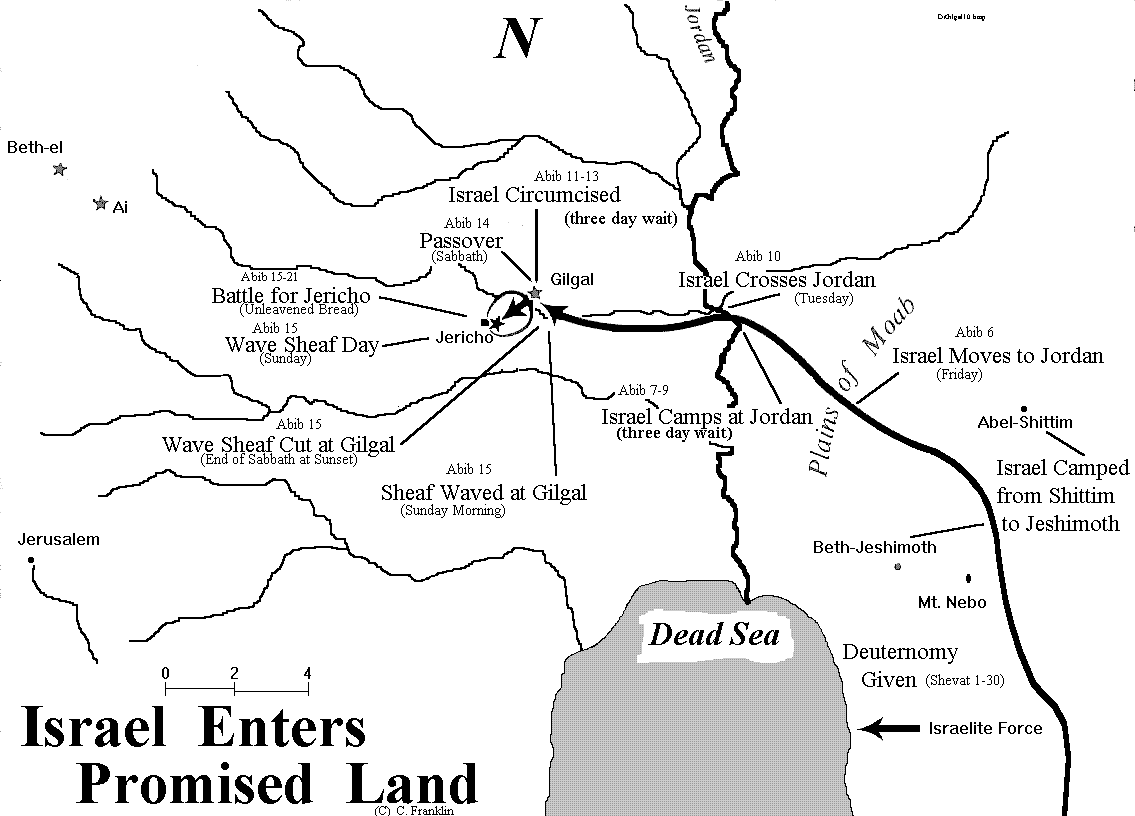
Based on the Scriptural records that are given in the book of Joshua, we can construct a calendar showing the exact chronology of major events as they occurred in the month of Abib in the year of entering the Promised Land. A sample calendar is included in this study paper. This calendar can serve as a guide in understanding the original observance of the wave sheaf on Abib 15. As an additional study aid, a map has been provided to illustrate the series of events which are recorded in Joshua's account. Let us learn from the example of the children of Israel as they were led by God to observe the first wave sheaf day in the Promised Land. By following the Scriptural example, we can have confidence that we are using the correct method for determining the wave sheaf day and beginning the count to Pentecost.
Special Calendar: Chronology of events in the book of Joshua Adobe Acrobat PDF
In order for you to view this document, you will need to have the free program installed. If you do not have it, please download the program here: http://get.adobe.com/reader/otherversions/
Special Map: Israel Enters the Promised Land
The Crossing
They came of 40 years a time of God's test, with Whom they often strove, now past the days of Moses' death and mourning, found them camped at the Acacia grove.
Then God gave command that morning next, after the third day's setting sun. That Israel stepped toward Jordan's down descent, with Joshua, son of Nun.
They sought to cross at Jordan's fords, inspired of God's own will. At water's edge which opened wide while Ark and priests stood still;
And so did pass through this dry bed, by river's walls heaped high. On tenth of month, in springtime came, beneath the Abib sky.
They picked up stones from Jordan’s path, to mark this great event unfolding.
And river's crossing now complete, pitched the promised camp, at the place called Rolling!
Copyright 1994 (C)
Dwight Blevins
Christian Biblical Church of God
P.O. Box 1442
Hollister, California USA 95024-1442
All rights reserved. Except for brief excerpts for review purposes, no. part of this publication may be reproduced or used in any form, or by any means--electronic or mechanical, including photocopying, recording, or information storage and retrieval systems--without written permission of copyright owner.