App
App
Section III
The Mother of the Child
Now while the mother derived her glory in the first instance from the divine character attributed to the child in her arms, the mother in the long-run practically eclipsed the son. At first, in all likelihood, there would be no thought whatever of ascribing divinity to the mother. There was an express promise that necessarily led mankind to expect that, at some time or other, the Son of God, in amazing condescension, should appear in this world as the Son of man. But there was no promise whatever, or the least shadow of a promise, to lead any one to anticipate that a woman should ever be invested with attributes that should raise her to a level with Divinity. It is in the last degree improbable, therefore, that when the mother was first exhibited with the child in her arms, it should be intended to give divine honours to her. She was doubtless used chiefly as a pedestal for the upholding of the divine Son, and holding him forth to the adoration of mankind; and glory enough it would be counted for her, alone of all the daughters of Eve, to have given birth to the promised seed, the world's only hope. But while this, no doubt, was the design, it is a plain principle in all idolatries that that which most appeals to the senses must make the most powerful impression. Now the Son, even in his new incarnation, when Nimrod was believed to have reappeared in a fairer form, was exhibited merely as a child, without any very particular attraction; while the mother in whose arms he was, was set off with all the art of painting and sculpture, as invested with much of that extraordinary beauty which in reality belonged to her. The beauty of Semiramis is said on one occasion to have quelled a rising rebellion among her subjects on her sudden appearance among them; and it is recorded that the memory of the admiration excited in their minds by her appearance on that occasion was perpetuated by a statue erected in Babylon, representing her in the guise in which she had fascinated them so much. *
* VALERIUS MAXIMUS. Valerius Maximus does not mention anything about the representation of Semiramis with the child in her arms; but as Semiramis was deified as Rhea, whose distinguishing character was that of goddess Mother, and as we have evidence that the name, "Seed of the Woman," or Zoroaster, goes back to the earliest times--viz., her own day (CLERICUS, De Chaldoeis), this implies that if there was any image-worship in these times, that "Seed of the Woman" must have occupied a prominent place in it. As over all the world the Mother and the child appear in some shape or other, and are found on the early Egyptian monuments, that shows that this worship must have had its roots in the primeval ages of the world. If, therefore, the mother was represented in so fascinating a form when singly represented, we may be sure that the same beauty for which she was celebrated would be given to her when exhibited with the child in her arms.
This Babylonian queen was not merely in character coincident with the Aphrodite of Greece and the Venus of Rome, but was, in point of fact, the historical original of that goddess that by the ancient world was regarded as the very embodiment of everything attractive in female form, and the perfection of female beauty; for Sanchuniathon assures us that Aphrodite or Venus was identical with Astarte, and Astarte being interpreted, is none other than "The woman that made towers or encompassing walls"--i.e., Semiramis. The Roman Venus, as is well known, was the Cyprian Venus, and the Venus of Cyprus is historically proved to have been derived from Babylon. Now, what in these circumstances might have been expected actually took place. If the child was to be adored, much more the mother. The mother, in point of fact, became the favourite object of worship. *
* How extraordinary, yea, frantic, was the devotion in the minds of the Babylonians to this goddess queen, is sufficiently proved by the statement of Herodotus, as to the way in which she required to be propitiated. That a whole people should ever have consented to such a custom as is there described, shows the amazing hold her worship must have gained over them. Nonnus, speaking of the same goddess, calls her "The hope of the whole world." (DIONUSIACA in BRYANT) It was the same goddess, as we have seen, who was worshipped at Ephesus, whom Demetrius the silversmith characterised as the goddess "whom all Asia and the world worshipped" (Acts 19:27). So great was the devotion to this goddess queen, not of the Babylonians only, but of the ancient world in general, that the fame of the exploits of Semiramis has, in history, cast the exploits of her husband Ninus or Nimrod, entirely into the shade.In regard to the identification of Rhea or Cybele and Venus, see note.
To justify this worship, the mother was raised to divinity as well as her son, and she was looked upon as destined to complete that bruising of the serpent's head, which it was easy, if such a thing was needed, to find abundant and plausible reasons for alleging that Ninus or Nimrod, the great Son, in his mortal life had only begun.
The Roman Church maintains that it was not so much the seed of the woman, as the woman herself, that was to bruise the head of the serpent. In defiance of all grammar, she renders the Divine denunciation against the serpent thus: "She shall bruise thy head, and thou shalt bruise her heel." The same was held by the ancient Babylonians, and symbolically represented in their temples. In the uppermost story of the tower of Babel, or temple of Belus, Diodorus Siculus tells us there stood three images of the great divinities of Babylon; and one of these was of a woman grasping a serpent's head. Among the Greeks the same thing was symbolised; for Diana, whose real character was originally the same as that of the great Babylonian goddess, was represented as bearing in one of her hands a serpent deprived of its head. As time wore away, and the facts of Semiramis' history became obscured, her son's birth was boldly declared to be miraculous: and therefore she was called "Alma Mater," * "the Virgin Mother."
* The term Alma is the precise term used by Isaiah in the Hebrew of the Old Testament, when announcing, 700 years before the event, that Christ should be born of a Virgin. If the question should be asked, how this Hebrew term Alma (not in a Roman, but a Hebrew sense) could find its way to Rome, the answer is, Through Etruria, which had an intimate connection with Assyria. The word "mater" itself, from which comes our own "mother," is originally Hebrew. It comes from Heb. Msh, "to draw forth," in Egyptian Ms, "to bring forth" (BUNSEN), which in the Chaldee form becomes Mt, whence the Egyptian Maut, "mother." Erh or Er, as in English (and a similar form is found in Sanscrit), is, "The doer." So that Mater or Mother signifies "The bringer forth."It may be thought an objection to the above account of the epithet Alma, that this term is often applied to Venus, who certainly was no virgin. But this objection is more apparent than real. On the testimony of Augustine, himself an eye-witness, we know that the rites of Vesta, emphatically "the virgin goddess of Rome," under the name of Terra, were exactly the same as those of Venus, the goddess of impurity and licentiousness (AUGUSTINE, De Civitate Dei). Augustine elsewhere says that Vesta, the virgin goddess, "was by some called Venus."
Even in the mythology of our own Scandinavian ancestors, we have a remarkable evidence that Alma Mater, or the Virgin Mother, had been originally known to them. One of their gods called Heimdal, who is described in the most exalted terms, as having such quick perceptions as that he could hear the grass growing on the ground, or the wool on the sheep's back, and whose trumpet, when it blew, could be heard through all the worlds, is called by the paradoxical name, "the son of nine virgins." (MALLET) Now this obviously contains an enigma. Let the language in which the religion of Odin was originally delivered--viz., the Chaldee, be brought to bear upon it, and the enigma is solved at once. In Chaldee "the son of nine virgins" is Ben-Almut-Teshaah. But in pronunciation this is identical with "Ben-Almet-Ishaa," "the son of the virgin of salvation." That son was everywhere known as the "saviour seed." "Zera-hosha" and his virgin mother consequently claimed to be "the virgin of salvation." Even in the very heavens the God of Providence has constrained His enemies to inscribe a testimony to the great Scriptural truth proclaimed by the Hebrew prophet, that a "virgin should bring forth a son, whose name should be called Immanuel." The constellation Virgo, as admitted by the most learned astronomers, was dedicated to Ceres (Dr. JOHN HILL, in his Urania, and Mr. A. JAMIESON, in his Celestial Atlas), who is the same as the great goddess of Babylon, for Ceres was worshipped with the babe at her breast (SOPHOCLES, Antigone), even as the Babylonian goddess was. Virgo was originally the Assyrian Venus, the mother of Bacchus or Tammuz. Virgo then, was the Virgin Mother. Isaiah's prophecy was carried by the Jewish captives to Babylon, and hence the new title bestowed upon the Babylonian goddess.
That the birth of the Great Deliverer was to be miraculous, was widely known long before the Christian era. For centuries, some say for thousands of years before that event, the Buddhist priests had a tradition that a Virgin was to bring forth a child to bless the world. That this tradition came from no Popish or Christian source, is evident from the surprise felt and expressed by the Jesuit missionaries, when they first entered Thibet and China, and not only found a mother and a child worshipped as at home, but that mother worshipped under a character exactly corresponding with that of their own Madonna, "Virgo Deipara," "The Virgin mother of God," * and that, too, in regions where they could not find the least trace of either the name or history of our Lord Jesus Christ having ever been known.
* See Sir J. F. DAVIS'S China, and LAFITAN, who says that the accounts sent home by the Popish missionaries bore that the sacred books of the Chinese spoke not merely of a Holy Mother, but of a Virgin Mother. For further evidence on this subject, see note
The primeval promise that the "seed of the woman should bruise the serpent's head," naturally suggested the idea of a miraculous birth. Priestcraft and human presumption set themselves wickedly to anticipate the fulfilment of that promise; and the Babylonian queen seems to have been the first to whom that honour was given. The highest titles were accordingly bestowed upon her. She was called the "queen of heaven." (Jer 44:17,18,19,25) *
* When Ashta, or "the woman," came to be called the "queen of heaven," the name "woman" became the highest title of honour applied to a female. This accounts for what we find so common among the ancient nations of the East, that queens and the most exalted personages were addressed by the name of "woman." "Woman" is not a complimentary title in our language; but formerly it had been applied by our ancestors in the very same way as among the Orientals; for our word "Queen" is derived from Cwino, which in the ancient Gothic just signified a woman.
In Egypt she was styled Athor--i.e., "the Habitation of God," (BUNSEN) to signify that in her dwelt all the "fulness of the Godhead." To point out the great goddess-mother, in a Pantheistic sense, as at once the Infinite and Almighty one, and the Virgin mother, this inscription was engraven upon one of her temples in Egypt: "I am all that has been, or that is, or that shall be. No mortal has removed my veil. The fruit which I have brought forth is the Sun." (Ibid.) In Greece she had the name of Hesita, and amongst the Romans, Vesta, which is just a modification of the same name--a name which, though it has been commonly understood in a different sense, really meant "The Dwelling-place." *
* Hestia, in Greek, signifies "a house" or "dwelling." This is usually thought to be a secondary meaning of the word, its proper meaning being believed to be "fire." But the statements made in regard to Hestia, show that the name is derived from Hes or Hese, "to cover, to shelter," which is the very idea of a house, which "covers" or "shelters" from the inclemency of the weather. The verb "Hes" also signifies "to protect," to "show mercy," and from this evidently comes the character of Hestia as "the protectress of suppliants." Taking Hestia as derived from Hes, "to cover," or "shelter," the following statement of Smith is easily accounted for: "Hestia was the goddess of domestic life, and the giver of all domestic happiness; as such she was believed to dwell in the inner part of every house, and to have invented the art of building houses." If "fire" be supposed to be the original idea of Hestia, how could "fire" ever have been supposed to be "the builder of houses"! But taking Hestia in the sense of the Habitation or Dwelling-place, though derived from Hes, "to shelter," or "cover," it is easy to see how Hestia would come to be identified with "fire." The goddess who was regarded as the "Habitation of God" was known by the name of Ashta, "The Woman"; while "Ashta" also signified "The fire"; and thus Hestia or Vesta, as the Babylonian system was developed, would easily come to be regarded as "Fire," or "the goddess of fire." For the reason that suggested the idea of the Goddess-mother being a Habitation, see note.
As the Dwelling-place of Deity, thus is Hestia or Vesta addressed in the Orphic Hymns:
"Daughter of Saturn, venerable dame,
Who dwell'st amid great fire's eternal flame,
In thee the gods have fix'd their DWELLING-PLACE,
Strong stable basis of the mortal race." *
* TAYLOR'S Orphic Hymns: Hymn to Vesta. Though Vesta is here called the daughter of Saturn, she is also identified in all the Pantheons with Cybele or Rhea, the wife of Saturn.
Even when Vesta is identified with fire, this same character of Vesta as "The Dwelling-place" still distinctly appears. Thus Philolaus, speaking of a fire in the middle of the centre of the world, calls it "The Vesta of the universe, The HOUSE of Jupiter, The mother of the gods." In Babylon, the title of the goddess-mother as the Dwelling-place of God was Sacca, or in the emphatic form, Sacta, that is, "The Tabernacle." Hence, at this day, the great goddesses in India, as wielding all the power of the god whom they represent, are called "Sacti," or the "Tabernacle." *
* KENNEDY and MOOR. A synonym for Sacca, "a tabernacle," is "Ahel," which, with the points, is pronounced "Ohel." From the first form of the word, the name of the wife of the god Buddha seems to be derived, which, in KENNEDY, is Ahalya, and in MOOR'S Pantheon, Ahilya. From the second form, in like manner, seems to be derived the name of the wife of the Patriarch of the Peruvians, "Mama Oello." (PRESCOTT'S Peru) Mama was by the Peruvians used in the Oriental sense: Oello, in all likelihood, was used in the same sense.
Now in her, as the Tabernacle or Temple of God, not only all power, but all grace and goodness were believed to dwell. Every quality of gentleness and mercy was regarded as centred in her; and when death had closed her career, while she was fabled to have been deified and changed into a pigeon, * to express the celestial benignity of her nature, she was called by the name of "D'Iune," ** or "The Dove," or without the article, "Juno"--the name of the Roman "queen of heaven," which has the very same meaning; and under the form of a dove as well as her own, she was worshipped by the Babylonians.
* DIODORUS SIC. In connection with this the classical reader will remember the title of one of the fables in OVID'S Metamorphoses. "Semiramis into a pigeon."** Dione, the name of the mother of Venus, and frequently applied to Venus herself, is evidently the same name as the above. Dione, as meaning Venus, is clearly applied by Ovid to the Babylonian goddess. (Fasti)
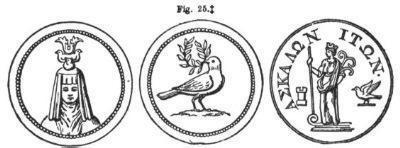
The dove, the chosen symbol of this deified queen, is commonly represented with an olive branch in her mouth (see figure 25), as she herself in her human form also is seen bearing the olive branch in her hand; and from this form of representing her, it is highly probable that she has derived the name by which she is commonly known, for "Z'emir-amit" means "The branch-bearer." *
* From Ze, "the" or "that," emir, "branch," and amit, "bearer," in the feminine. HESYCHIUS says that Semiramis is a name for a "wild pigeon." The above explanation of the original meaning of the name Semiramis, as referring to Noah's wild pigeon (for it was evidently a wild one, as the tame one would not have suited the experiment), may account for its application by the Greeks to any wild pigeon.
When the goddess was thus represented as the Dove with the olive branch, there can be no doubt that the symbol had partly reference to the story of the flood; but there was much more in the symbol than a mere memorial of that great event. "A branch," as has been already proved, was the symbol of the deified son, and when the deified mother was represented as a Dove, what could the meaning of this representation be but just to identify her with the Spirit of all grace, that brooded, dove-like, over the deep at the creation; for in the sculptures at Nineveh, as we have seen, the wings and tail of the dove represented the third member of the idolatrous Assyrian trinity. In confirmation of this view, it must be stated that the Assyrian "Juno," or "The Virgin Venus," as she was called, was identified with the air. Thus Julius Firmicus says: "The Assyrians and part of the Africans wish the air to have the supremacy of the elements, for they have consecrated this same [element] under the name of Juno, or the Virgin Venus." Why was air thus identified with Juno, whose symbol was that of the third person of the Assyrian trinity? Why, but because in Chaldee the same word which signifies the air signifies also the "Holy Ghost." The knowledge of this entirely accounts for the statement of Proclus, that "Juno imports the generation of soul." Whence could the soul--the spirit of man--be supposed to have its origin, but from the Spirit of God. In accordance with this character of Juno as the incarnation of the Divine Spirit, the source of life, and also as the goddess of the air, thus is she invoked in the "Orphic Hymns":
"O royal Juno, of majestic mien,
Aerial formed, divine, Jove's blessed queen,
Throned in the bosom of caerulean air,
The race of mortals is thy constant care;
The cooling gales, thy power alone inspires,
Which nourish life, which every life desires;
Mother of showers and winds, from thee alone
Producing all things, mortal life is known;
All natures show thy temperament divine,
And universal sway alone is thine,
With sounding blasts of wind, the swelling sea
And rolling rivers roar when shook by thee." *
* TAYLOR'S Orphic Hymns. Every classical reader must be aware of the identification of Juno with the air. The following, however, as still further illustrative of the subject from Proclus, may not be out of place: "The series of our sovereign mistress Juno, beginning from on high, pervades the last of things, and her allotment in the sublunary region is the air; for air is a symbol of soul, according to which also soul is called a spirit."
Thus, then, the deified queen, when in all respects regarded as a veritable woman, was at the same time adored as the incarnation of the Holy Ghost, the Spirit of peace and love. In the temple of Hierapolis in Syria, there was a famous statue of the goddess Juno, to which crowds from all quarters flocked to worship. The image of the goddess was richly habited, on her head was a golden dove, and she was called by a name peculiar to the country, "Semeion." (BRYANT) What is the meaning of Semeion? It is evidently "The Habitation"; * and the "golden dove" on her head shows plainly who it was that was supposed to dwell in her--even the Spirit of God.
* From Ze, "that," or "the great," and "Maaon," or Maion, "a habitation," which, in the Ionic dialect, in which Lucian, the describer of the goddess, wrote, would naturally become Meion.
When such transcendent dignity was bestowed on her, when such winning characters were attributed to her, and when, over and above all, her images presented her to the eyes of men as Venus Urania, "the heavenly Venus," the queen of beauty, who assured her worshippers of salvation, while giving loose reins to every unholy passion, and every depraved and sensual appetite--no wonder that everywhere she was enthusiastically adored. Under the name of the "Mother of the gods," the goddess queen of Babylon became an object of almost universal worship. "The Mother of the gods," says Clericus, "was worshipped by the Persians, the Syrians, and all the kings of Europe and Asia, with the most profound religious veneration." Tacitus gives evidence that the Babylonian goddess was worshipped in the heart of Germany, and Caesar, when he invaded Britain, found that the priests of this same goddess, known by the name of Druids, had been there before him. *
* CAESAR, De Bello Gallico. The name Druid has been thought to be derived from the Greek Drus, an oak tree, or the Celtic Deru, which has the same meaning; but this is obviously a mistake. In Ireland, the name for a Druid is Droi, and in Wales Dryw; and it will be found that the connection of the Druids with the oak was more from the mere similarity of their name to that of the oak, than because they derived their name from it. The Druidic system in all its parts was evidently the Babylonian system. Dionysius informs us, that the rites of Bacchus were duly celebrated in the British Islands and Strabo cites Artemidorus to show that, in an island close to Britain, Ceres and Proserpine were venerated with rites similar to the orgies of Samothrace. It will be seen from the account of the Druidic Ceridwen and her child, afterwards to be noticed (see Chapter IV, Section III), that there was a great analogy between her character and that of the great goddess-mother of Babylon. Such was the system; and the name Dryw, or Droi, applied to the priests, is in exact accordance with that system. The name Zero, given in Hebrew or the early Chaldee, to the son of the great goddess queen, in later Chaldee became "Dero." The priest of Dero, "the seed," was called, as is the case in almost all religions, by the name of his god; and hence the familiar name "Druid" is thus proved to signify the priest of "Dero"--the woman's promised "seed." The classical Hamadryads were evidently in like manner priestesses of "Hamed-dero,"--"the desired seed"--i.e., "the desire of all nations."
Herodotus, from personal knowledge, testifies, that in Egypt this "queen of heaven" was "the greatest and most worshipped of all the divinities." Wherever her worship was introduced, it is amazing what fascinating power it exerted. Truly, the nations might be said to be "made drunk" with the wine of her fornications. So deeply, in particular, did the Jews in the days of Jeremiah drink of her wine cup, so bewitched were they with her idolatrous worship, that even after Jerusalem had been burnt, and the land desolated for this very thing, they could not be prevailed on to give it up. While dwelling in Egypt as forlorn exiles, instead of being witnesses for God against the heathenism around them, they were as much devoted to this form of idolatry as the Egyptians themselves. Jeremiah was sent of God to denounce wrath against them, if they continued to worship the queen of heaven; but his warnings were in vain.
"Then," saith the prophet, "all the men which knew that their wives had burnt incense unto other gods, and all the women that stood by, a great multitude, even all the people that dwelt in the land of Egypt, in Pathros, answered Jeremiah, saying, As for the word that thou hast spoken unto us in the name of the Lord, we will not hearken unto thee; but we will certainly do whatsoever thing goeth forth out of our own mouth, to burn incense unto the queen of heaven, and to pour out drink-offerings unto her, as we have done, we, and our fathers, our kings, and our princes, in the cities of Judah, and in the streets of Jerusalem; for then had we plenty of victuals, and were well, and saw no evil" (Jer 44:15-17).
Thus did the Jews, God's own peculiar people, emulate the Egyptians in their devotion to the queen of heaven.
The worship of the goddess-mother with the child in her arms continued to be observed in Egypt till Christianity entered. If the Gospel had come in power among the mass of the people, the worship of this goddess-queen would have been overthrown. With the generality it came only in name. Instead, therefore, of the Babylonian goddess being cast out, in too many cases her name only was changed. She was called the Virgin Mary, and, with her child, was worshipped with the same idolatrous feeling by professing Christians, as formerly by open and avowed Pagans. The consequence was, that when, in AD 325, the Nicene Council was summoned to condemn the heresy of Arius, who denied the true divinity of Christ, that heresy indeed was condemned, but not without the help of men who gave distinct indications of a desire to put the creature on a level with the Creator, to set the Virgin-mother side by side with her Son. At the Council of Nice, says the author of "Nimrod," "The Melchite section"--that is, the representatives of the so-called Christianity of Egypt--"held that there were three persons in the Trinity--the Father, the Virgin Mary, and Messiah their Son." In reference to this astounding fact, elicited by the Nicene Council, Father Newman speaks exultingly of these discussions as tending to the glorification of Mary. "Thus," says he, "the controversy opened a question which it did not settle. It discovered a new sphere, if we may so speak, in the realms of light, to which the Church had not yet assigned its inhabitant. Thus, there was a wonder in Heaven; a throne was seen far above all created powers, mediatorial, intercessory, a title archetypal, a crown bright as the morning star, a glory issuing from the eternal throne, robes pure as the heavens, and a sceptre over all. And who was the predestined heir of that majesty? Who was that wisdom, and what was her name, the mother of fair love, and far, and holy hope, exalted like a palm-tree in Engaddi, and a rose-plant in Jericho, created from the beginning before the world, in God's counsels, and in Jerusalem was her power? The vision is found in the Apocalypse 'a Woman clothed with the sun, and the moon under her feet, and upon her head a crown of twelve stars.'" *
* NEWMAN'S Development. The intelligent reader will see at a glance the absurdity of applying this vision of the "woman" of the Apocalypse to the Virgin Mary. John expressly declares that what he saw was a "sign" or "symbol" (semeion). If the woman here is a literal woman, the woman that sits on the seven hills must be the same. "The woman" in both cases is a "symbol." "The woman" on the seven hills is the symbol of the false church; the woman clothed with the sun, of the true church--the Bride, the Lamb's wife.
"The votaries of Mary," adds he, "do not exceed the true faith, unless the blasphemers of her Son came up to it. The Church of Rome is not idolatrous, unless Arianism is orthodoxy." This is the very poetry of blasphemy. It contains an argument too; but what does that argument amount to? It just amounts to this, that if Christ be admitted to be truly and properly God, and worthy of Divine honours, His mother, from whom He derived merely His humanity, must be admitted to be the same, must be raised far above the level of all creatures, and be worshipped as a partaker of the Godhead. The divinity of Christ is made to stand or fall with the divinity of His mother. Such is Popery in the nineteenth century; yea, such is Popery in England. It was known already that Popery abroad was bold and unblushing in its blasphemies; that in Lisbon a church was to be seen with these words engraven on its front, "To the virgin goddess of Loretto, the Italian race, devoted to her DIVINITY, have dedicated this temple." (Journal of Professor GIBSON, in Scottish Protestant) But when till now was such language ever heard in Britain before? This, however, is just the exact reproduction of the doctrine of ancient Babylon in regard to the great goddess-mother. The Madonna of Rome, then, is just the Madonna of Babylon. The "Queen of Heaven" in the one system is the same as the "Queen of Heaven" in the other. The goddess worshipped in Babylon and Egypt as the Tabernacle or Habitation of God, is identical with her who, under the name of Mary, is called by Rome "The HOUSE consecrated to God," "the awful Dwelling-place," * "the Mansion of God" (Pancarpium Marioe), the "Tabernacle of the Holy Ghost" (Garden of the Soul), the "Temple of the Trinity" (Golden Manual in Scottish Protestant).
* The Golden Manual in Scottish Protestant. The word here used for "Dwelling-place" in the Latin of this work is a pure Chaldee word--"Zabulo," and is from the same verb as Zebulun (Gen 30:20), the name which was given by Leah to her son, when she said "Now will my husband dwell with me."
Some may possibly be inclined to defend such language, by saying that the Scripture makes every believer to be a temple of the Holy Ghost, and, therefore, what harm can there be in speaking of the Virgin Mary, who was unquestionably a saint of God, under that name, or names of a similar import? Now, no doubt it is true that Paul says (1 Cor 3:16),
"Know ye not that ye are the temple of God, and that the Spirit of God dwelleth in you?"
It is not only true, but it is a great truth, and a blessed one--a truth that enhances every comfort when enjoyed, and takes the sting out of every trouble when it comes, that every genuine Christian has less or more experience of what is contained in these words of the same apostle (2 Cor 6:16),
"Ye are the temple of the living God; as God hath said, I will dwell in them and walk in them, and I will be their God, and they shall be my people."
It must also be admitted, and gladly admitted, that this implies the indwelling of all the Persons of the glorious Godhead; for the Lord Jesus hath said (John 14:23),
"If a man love me, he will keep my words; and my Father will love him, and WE will come unto him, and make our abode with him."
But while admitting all this, on examination it will be found that the Popish and the Scriptural ideas conveyed by these expressions, however apparently similar, are essentially different. When it is said that a believer is "a temple of God," or a temple of the Holy Ghost, the meaning is (Eph 3:17) that "Christ dwells in the heart by faith." But when Rome says that Mary is "The Temple" or "Tabernacle of God," the meaning is the exact Pagan meaning of the term--viz., that the union between her and the Godhead is a union akin to the hypostatical union between the divine and human nature of Christ. The human nature of Christ is the "Tabernacle of God," inasmuch as the Divine nature has veiled its glory in such a way, by assuming our nature, that we can come near without overwhelming dread to the Holy God. To this glorious truth John refers when he says (John 1:14),
"The Word was made flesh, and dwelt (literally tabernacled) among us, and we beheld His glory, the glory as of the only begotten of the Father, full of grace and truth."
In this sense, Christ, the God-man, is the only "Tabernacle of God." Now, it is precisely in this sense that Rome calls Mary the "Tabernacle of God," or of the "Holy Ghost." Thus speaks the author of a Popish work devoted to the exaltation of the Virgin, in which all the peculiar titles and prerogatives of Christ are given to Mary: "Behold the tabernacle of God, the mansion of God, the habitation, the city of God is with men, and in men and for men, for their salvation, and exaltation, and eternal glorification...Is it most clear that this is true of the holy church? and in like manner also equally true of the most holy sacrament of the Lord's body? Is it (true) of every one of us in as far as we are truly Christians? Undoubtedly; but we have to contemplate this mystery (as existing) in a peculiar manner in the most holy Mother of our Lord." (Pancarpium Marioe) Then the author, after endeavouring to show that "Mary is rightly considered as the Tabernacle of God with men," and that in a peculiar sense, a sense different from that in which all Christians are the "temple of God," thus proceeds with express reference to her in this character of the Tabernacle: "Great truly is the benefit, singular is the privilege, that the Tabernacle of God should be with men, IN WHICH men may safely come near to God become man." (Ibid.) Here the whole mediatorial glory of Christ, as the God-man in whom dwelleth all the fullness of the Godhead bodily, is given to Mary, or at least is shared with her. The above extracts are taken from a work published upwards of two hundred years ago. Has the Papacy improved since then? Has it repented of its blasphemies? No, the very reverse. The quotation already given from Father Newman proves this; but there is still stronger proof. In a recently published work, the same blasphemous idea is even more clearly unfolded. While Mary is called "The HOUSE consecrated to God," and the "TEMPLE of the Trinity," the following versicle and response will show in what sense she is regarded as the temple of the Holy Ghost: "V. The Lord himself created HER in the Holy Ghost, and POURED HER out among all his works. V. O Lady, hear," &c. This astounding language manifestly implies that Mary is identified with the Holy Ghost, when it speaks of her "being poured out" on "all the works of God"; and that, as we have seen, was just the very way in which the Woman, regarded as the "Tabernacle" or House of God by the Pagans, was looked upon. Where is such language used in regard to the Virgin? Not in Spain; not in Austria; not in the dark places of Continental Europe; but in London, the seat and centre of the world's enlightenment.
The names of blasphemy bestowed by the Papacy on Mary have not one shadow of foundation in the Bible, but are all to be found in the Babylonian idolatry. Yea, the very features and complexions of the Roman and Babylonian Madonnas are the same. Till recent times, when Raphael somewhat departed from the beaten track, there was nothing either Jewish or even Italian in the Romish Madonnas. Had these pictures or images of the Virgin Mother been intended to represent the mother of our Lord, naturally they would have been cast either in the one mould or the other. But it was not so. In a land of dark-eyed beauties, with raven locks, the Madonna was always represented with blue eyes and golden hair, a complexion entirely different form the Jewish complexion, which naturally would have been supposed to belong to the mother of our Lord, but which precisely agrees with that which all antiquity attributes to the goddess queen of Babylon.
In almost all lands the great goddess has been described with golden or yellow hair, showing that there must have been one grand prototype, to which they were all made to correspond. The "yellow-haired Ceres," might not have been accounted of any weight in this argument if she had stood alone, for it might have been supposed in that case that the epithet "yellow-haired" was borrowed from the corn that was supposed to be under her guardian care. But many other goddesses have the very same epithet applied to them. Europa, whom Jupiter carried away in the form of a bull, is called "The yellow-haired Europa." (OVID, Fasti) Minerva is called by Homer "the blue-eyed Minerva," and by Ovid "the yellow-haired"; the huntress Diana, who is commonly identified with the moon, is addressed by Anacreon as "the yellow-haired daughter of Jupiter," a title which the pale face of the silver moon could surely never have suggested. Dione, the mother of Venus, is described by Theocritus as "yellow-haired." Venus herself is frequently called "Aurea Venus," the "golden Venus." (HOMER'S Iliad) The Indian goddess Lakshmi, the "Mother of the Universe," is described as of "a golden complexion." (Asiatic Researches) Ariadne, the wife of Bacchus, was called "the yellow-haired Ariadne." (HESIOD, Theogonia) Thus does Dryden refer to her golden or yellow hair:
"Where the rude waves in Dian's harbour play,
The fair forsaken Ariadne lay;
There, sick with grief and frantic with despair,
Her dress she rent, and tore her golden hair."
The Gorgon Medusa before her transformation, while celebrated for her beauty, was equally celebrated for her golden hair:
"Medusa once had charms: to gain her love
A rival crowd of anxious lovers strove.
They who have seen her, own they ne'er did trace
More moving features in a sweeter face;
But above all, her length of hair they own
In golden ringlets waves, and graceful shone."
The mermaid that figured so much in the romantic tales of the north, which was evidently borrowed from the story of Atergatis, the fish goddess of Syria, who was called the mother of Semiramis, and was sometimes identified with Semiramis herself, was described with hair of the same kind. "The Ellewoman," such is the Scandinavian name for the mermaid, "is fair," says the introduction to the "Danish Tales" of Hans Andersen, "and gold-haired, and plays most sweetly on a stringed instrument." "She is frequently seen sitting on the surface of the waters, and combing her long golden hair with a golden comb." Even when Athor, the Venus of Egypt, was represented as a cow, doubtless to indicate the complexion of the goddess that cow represented, the cow's head and neck were gilded. (HERODOTUS and WILKINSON) When, therefore, it is known that the most famed pictures of the Virgin Mother in Italy represented her as of a fair complexion and with golden hair, and when over all Ireland the Virgin is almost invariably represented at this day in the very same manner, who can resist the conclusion that she must have been thus represented, only because she had been copied form the same prototype as the Pagan divinities?
Nor is this agreement in complexion only, but also in features. Jewish features are everywhere marked, and have a character peculiarly their own. But the original Madonnas have nothing at all of Jewish form or feature; but are declared by those who have personally compared both, entirely to agree in this respect, as well as in complexion, with the Babylonian Madonnas found by Sir Robert Ker Porter among the ruins of Babylon.
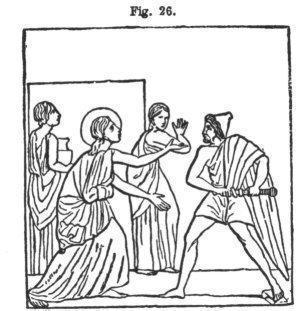 There is yet another remarkable characteristic of these pictures worthy of notice, and that is the nimbus or peculiar circle of light that frequently encompasses the head of the Roman Madonna. With this circle the heads of the so-called figures of Christ are also frequently surrounded. Whence could such a device have originated? In the case of our Lord, if His head had been merely surrounded with rays, there might have been some pretence for saying that that was borrowed from the Evangelic narrative, where it is stated, that on the holy mount His face became resplendent with light. But where, in the whole compass of Scripture, do we ever read that His head was surrounded with a disk, or a circle of light? But what will be searched for in vain in the Word of God, is found in he artistic representations of the great gods and goddesses of Babylon. The disk, and particularly the circle, were the well known symbols of the Sun-divinity, and figured largely in the symbolism of the East. With the circle or the disk the head of the Sun-divinity was encompassed. The same was the case in Pagan Rome. Apollo, as the child of the Sun, was often thus represented. The goddesses that claimed kindred with the Sun were equally entitled to be adorned with the nimbus or luminous circle. From Pompeii there is a representation of Circe, "the daughter of the Sun" (see figure 26) with her head surrounded with a circle, in the very same way as the head of the Roman Madonna is at this day surrounded. Let any one compare the nimbus around the head of Circe, with that around the head of the Popish Virgin, and he will see how exactly they correspond. *
* The explanation of the figure is thus given in Pompeii: "One of them [the paintings] is taken from the Odyssey, and represents Ulysses and Circe, at the moment when the hero, having drunk the charmed cup with impunity, by virtue of the antidote given him by Mercury [it is well known that Circe had a 'golden cup,' even as the Venus of Babylon had], draws his sword, and advances to avenge his companions," who, having drunk of her cup, had been changed into swine. The goddess, terrified, makes her submission at once, as described by Homer; Ulysses himself being the narrator:
"Hence, seek the sty, there wallow with thy friends,
She spake, I drawing from beside my thigh
My Falchion keen, with death-denouncing looks,
Rushed on her; she, with a shrill scream of fear,
Ran under my raised arm, seized fast my knees,
And in winged accents plaintive, thus began:
'Say, who art thou,'" &c.--COWPER'S Odyssey"This picture," adds the author of Pompeii, "is remarkable, as teaching us the origin of that ugly and unmeaning glory by which the heads of saints are often surrounded...This glory was called nimbus, or aureola, and is defined by Servius to be 'the luminous fluid which encircles the heads of the gods.' It belongs with peculiar propriety to Circe, as the daughter of the Sun. The emperors, with their usual modesty, assumed it as the mark of their divinity; and under this respectable patronage it passed, like many other Pagan superstitions and customs, into the use of the Church." The emperors here get rather more than a fair share of the blame due to them. It was not the emperors that brought "Pagan superstition" into the Church, so much as the Bishop of Rome. See Chapter VII, Section II.
Now, could any one possibly believe that all this coincidence could be accidental. Of course, if the Madonna had ever so exactly resembled the Virgin Mary, that would never have excused idolatry. But when it is evident that the goddess enshrined in the Papal Church for the supreme worship of its votaries, is that very Babylonian queen who set up Nimrod, or Ninus "the Son," as the rival of Christ, and who in her own person was the incarnation of every kind of licentiousness, how dark a character does that stamp on the Roman idolatry. What will it avail to mitigate the heinous character of that idolatry, to say that the child she holds forth to adoration is called by the name of Jesus? When she was worshipped with her child in Babylon of old, that child was called by a name as peculiar to Christ, as distinctive of His glorious character, as the name of Jesus. He was called "Zoro-ashta," "the seed of the woman." But that did not hinder the hot anger of God from being directed against those in the days of old who worshipped that "image of jealousy, provoking to jealousy." *
* Ezekiel 8:3. There have been many speculations about what this "image of jealousy" could be. But when it is known that the grand feature of ancient idolatry was just the worship of the Mother and the child, and that child as the Son of God incarnate, all is plain. Compare verses 3 and 5 with verse 14, and it will be seen that the "women weeping for Tammuz" were weeping close beside the image of jealousy.
Neither can the giving of the name of Christ to the infant in the arms of the Romish Madonna, make it less the "image of jealousy," less offensive to the Most High, less fitted to provoke His high displeasure, when it is evident that that infant is worshipped as the child of her who was adored as Queen of Heaven, with all the attributes of divinity, and was at the same time the "Mother of harlots and abominations of the earth." Image-worship in every case the Lord abhors; but image-worship of such a kind as this must be peculiarly abhorrent to His holy soul. Now, if the facts I have adduced be true, is it wonderful that such dreadful threatenings should be directed in the Word of God against the Romish apostacy, and that the vials of this tremendous wrath are destined to be outpoured upon its guilty head? If these things be true (and gainsay them who can), who will venture now to plead for Papal Rome, or to call her a Christian Church? Is there one, who fears God, and who reads these lines, who would not admit that Paganism alone could ever have inspired such a doctrine as that avowed by the Melchites at the Nicene Council, that the Holy Trinity consisted of "the Father, the Virgin Mary, and the Messiah their Son"? (Quarterly Journal of Prophecy, July, 1852) Is there one who would not shrink with horror from such a thought? What, then, would the reader say of a Church that teaches its children to adore such a Trinity as that contained in the following lines?
"Heart of Jesus, I adore thee;
Heart of Mary, I implore thee;
Heart of Joseph, pure and just;
IN THESE THREE HEARTS I PUT MY TRUST." *
* What every Christian must Know and Do. By the Rev. J. FURNISS. Published by James Duffy, Dublin. The edition of this Manual of Popery quoted above, besides the blasphemy it contains, contains most immoral principles, teaching distinctly the harmlessness of fraud, if only kept within due bounds. On this account, a great outcry having been raised against it, I believe this edition has been withdrawn from general circulation. The genuineness of the passage above given is, however, beyond all dispute. I received myself from a fried in Liverpool a copy of the edition containing these words, which is now in my possession, having previously seen them in a copy in the possession of the Rev. Richard Smyth of Armagh. It is not in Ireland, however, only, that such a trinity is exhibited for the worship of Romanists. In a Card, or Fly-leaf, issued by the Popish priests of Sunderland, now lying before me, with the heading "Paschal Duty, St. Mary's Church, Bishopwearmouth, 1859," the following is the 4th admonition given to the "Dear Christians" to whom it is addressed:"4. And never forget the acts of a good Christian, recommended to you so often during the renewal of the Mission.
Blessed be Jesus, Mary, and Joseph.
Jesus, Mary, and Joseph, I give you my heart, my life, and my soul.
Jesus, Mary, and Joseph, assist me always; and in my last agony,
Jesus, Mary, and Joseph, receive my last breath. Amen."To induce the adherents of Rome to perform this "act of a good Christian," a considerable bribe is held out. In p. 30 of Furniss' Manual above referred to, under the head "Rule of Life," the following passage occurs: "In the morning, before you get up, make the sign of the cross, and say, Jesus, Mary, and Joseph, I give you my heart and my soul. (Each time you say this prayer, you get an indulgence of 100 days, which you can give to the souls in Purgatory)!" I must add that the title of Furniss' book, as given above, is the title of Mr. Smyth's copy. The title of the copy in my possession is "What every Christian must Know." London: Richardson & Son, 147 Strand. Both copies alike have the blasphemous words given in the text, and both have the "Imprimatur" of "Paulus Cullen."
If this is not Paganism, what is there that can be called by such a name? Yet this is the Trinity which now the Roman Catholics of Ireland from tender infancy are taught to adore. This is the Trinity which, in the latest books of catechetical instruction is presented as the grand object of devotion to the adherents of the Papacy. The manual that contains this blasphemy comes forth with the express "Imprimatur" of "Paulus Cullen," Popish Archbishop of Dublin. Will any one after this say that the Roman Catholic Church must still be called Christian, because it holds the doctrine of the Trinity? So did the Pagan Babylonians, so did the Egyptians, so do the Hindoos at this hour, in the very same sense in which Rome does. They all admitted A trinity, but did they worship THE Triune Jehovah, the King Eternal, Immortal, and Invisible? And will any one say with such evidence before him, that Rome does so? Away then, with the deadly delusion that Rome is Christian! There might once have been some palliation for entertaining such a supposition; but every day the "Grand Mystery" is revealing itself more and more in its true character. There is not, and there cannot be, any safety for the souls of men in "Babylon." "Come out of her, my people," is the loud and express command of God. Those who disobey that command, do it at their peril.
Notes
The Identification of Rhea or Cybele and Venus
Note 1: In the exoteric doctrine of Greece and Rome, the characters of Cybele, the mother of the gods, and of Venus, the goddess of love, are generally very distinct, insomuch that some minds may perhaps find no slight difficulty in regard to the identification of these two divinities. But that difficulty will disappear, if the fundamental principle of the Mysteries be borne in mind--viz., that at bottom they recognised only Adad, "The One God." Adad being Triune, this left room, when the Babylonian Mystery of Iniquity took shape, for three different FORMS of divinity--the father, the mother, and the son; but all the multiform divinities with which the Pagan world abounded, whatever diversities there were among them, were resolved substantially into so many manifestations of one or other of these divine persons, or rather of two, for the first person was generally in the background. We have distinct evidence that this was the case. Apuleius tells us, that when he was initiated, the goddess Isis revealed herself to him as "The first of the celestials, and the uniform manifestation of the gods and goddesses...WHOSE ONE SOLE DIVINITY the whole orb of the earth venerated, and under a manifold form, with different rites, and under a variety of appellations"; and going over many of these appellations, she declares herself to be at once "Pessinuntica, the mother of the gods [i.e. Cybele], and Paphian Venus."
Now, as this was the case in the later ages of the Mysteries, so it must have been the case from the very beginning; because they SET OUT, and necessarily set out, with the doctrine of the UNITY of the Godhead. This, of course, would give rise to no little absurdity and inconsistency in the very nature of the case. Both Wilkinson and Bunsen, to get rid of the inconsistencies they have met with in the Egyptian system, have found it necessary to have recourse to substantially the same explanation as I have done. Thus we find Wilkinson saying: "I have stated that Amun-re and other gods took the form of different deities, which, though it appears at first sight to present some difficulty, may readily be accounted for when we consider that each of those whose figures or emblem were adopted, was only an EMANATION, or deified attribute of the SAME GREAT BEING to whom they ascribed various characters, according to the several offices he was supposed to perform." The statement of Bunsen is to the same effect, and it is this: "Upon these premises, we think ourselves justified in concluding that the two series of gods were originally identical, and that, in the GREAT PAIR of gods, all those attributes were concentrated, from the development of which, in various personifications, that mythological system sprang up which we have been already considering."
The bearing of all this upon the question of the identification of Cybele and Astarte, or Venus, is important. Fundamentally, there was but one goddess--the Holy Spirit, represented as female, when the distinction of sex was wickedly ascribed to the Godhead, through a perversion of the great Scripture idea, that all the children of God are at once begotten of the Father, and born of the Spirit; and under this idea, the Spirit of God, as Mother, was represented under the form of a dove, in memory of the fact that that Spirit, at the creation, "fluttered"--for so, as I have observed, is the exact meaning of the term in Genesis 1:2--"on the face of the waters." This goddess, then, was called Ops, "the flutterer," or Juno, "The Dove," or Khubele, "The binder with cords," which last title had reference to "the bands of love, the cords of a man" (called in Hosea 11:4, "Khubeli Adam"), with which not only does God continually, by His providential goodness, draw men unto Himself, but with which our first parent Adam, through the Spirit's indwelling, while the covenant of Eden was unbroken, was sweetly bound to God. This theme is minutely dwelt on in Pagan story, and the evidence is very abundant; but I cannot enter upon it here. Let this only be noticed, however, that the Romans joined the two terms Juno and Khubele--or, as it is commonly pronounced, Cybele--together; and on certain occasions invoked their supreme goddess, under the name of Juno Covella--that is, "The dove that binds with cords."
If the reader looks, in Layard, at the triune emblem of the supreme Assyrian divinity, he will see this very idea visibly embodied. There the wings and tail of the dove have two bands associated with them instead of feet (LAYARD'S Nineveh and its Remains, vol. ii. p. 418; see also accompanying woodcut (see figure 61), from BRYANT, vol. ii. p. 216; and KITTO's Bib. Cyclop., vol. i. p. 425).
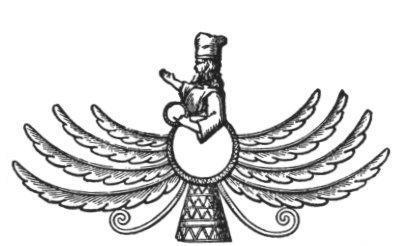
In reference to events after the Fall, Cybele got a new idea attached to her name. Khubel signifies not only to "bind with cords," but also "to travail in birth"; and therefore Cybele appeared as the "Mother of the gods," by whom all God's children must be born anew or regenerated. But, for this purpose, it was held indispensable that there should be a union in the first instance with Rhea, "The gazer," the human "mother of gods and men," that the ruin she had introduced might be remedied. Hence the identification of Cybele and Rhea, which in all the Pantheons are declared to be only two different names of the same goddess, though, as we have seen, these goddesses were in reality entirely distinct. This same principle was applied to all the other deified mothers. They were deified only through the supposed miraculous identification with them of Juno or Cybele--in other words, of the Holy Spirit of God. Each of these mothers had her own legend, and had special worship suited thereto; but, as in all cases, she was held to be an incarnation of the one spirit of God, as the great Mother of all, the attributes of that one Spirit were always pre-supposed as belonging to her. This, then, was the case with the goddess recognised as Astarte or Venus, as well as with Rhea. Though there were points of difference between Cybele, or Rhea, and Astarte or Mylitta, the Assyrian Venus, Layard shows that there were also distinct points of contact between them. Cybele or Rhea was remarkable for her turreted crown. Mylitta, or Astarte, was represented with a similar crown. Cybele, or Rhea, was drawn by lions; Mylitta, or Astarte, was represented as standing on a lion. The worship of Mylitta, or Astarte, was a mass of moral pollution (HERODOTUS). The worship of Cybele, under the name of Terra, was the same (AUGUSTINE, De Civitate).
The first deified woman was no doubt Semiramis, as the first deified man was her husband. But it is evident that it was some time after the Mysteries began that this deification took place; for it was not till after Semiramis was dead that she was exalted to divinity, and worshipped under the form of a dove. When, however, the Mysteries were originally concocted, the deeds of Eve, who, through her connection with the serpent, brought forth death, must necessarily have occupied a place; for the Mystery of sin and death lies at the very foundation of all religion, and in the age of Semiramis and Nimrod, and Shem and Ham, all men must have been well acquainted with the facts of the Fall. At first the sin of Eve may have been admitted in all its sinfulness (otherwise men generally would have been shocked, especially when the general conscience had been quickened through the zeal of Shem); but when a woman was to be deified, the shape that the mystic story came to assume shows that that sin was softened, yea, that it changed its very character, and that by a perversion of the name given to Eve, as "the mother of all living ones," that is, all the regenerate, she was glorified as the authoress of spiritual life, and, under the very name Rhea, was recognised as the mother of the gods. Now, those who had the working of the Mystery of Iniquity did not find it very difficult to show that this name Rhea, originally appropriate to the mother of mankind, was hardly less appropriate for her who was the actual mother of the gods, that is, of all the deified mortals. Rhea, in the active sense, signifies "the Gazing woman," but in the passive it signifies "The woman gazed at," that is, "The beauty," and thus, under one and the same term, the mother of mankind and the mother of the Pagan gods, that is, Semiramis, were amalgamated; insomcuh, that now, as is well known, Rhea is currently recognised as the "Mother of gods and men" (HESIOD, Theogon). It is not wonderful, therefore that the name Rhea is found applied to her, who, by the Assyrians, was worshipped in the very character of Astarte or Venus.
Note 2:"Almost all the Tartar princes," says SALVERTE (Des Sciences Occultes), "trace their genealogy to a celestial virgin, impregnated by a sun-beam, or some equally miraculous means." In India, the mother of Surya, the sun-god, who was born to destroy the enemies of the gods, is said to have become pregnant in this way, a beam of the sun having entered her womb, in consequence of which she brought forth the sun-god. Now the knowledge of this widely diffused myth casts light on the secret meaning of the name Aurora, given to the wife of Orion, to whose marriage with that "mighty hunter" Homer refers (Odyssey). While the name Aur-ora, in the physical sense, signifies also "pregnant with light"; and from "ohra," "to conceive" or be "pregnant," we have in Greek, the word for a wife. As Orion, according to Persian accounts, was Nimrod; and Nimrod, under the name of Ninus, was worshipped as the son of his wife, when he came to be deified as the sun-god, that name Aurora, as applied to his wife, is evidently intended to convey the very same idea as prevails in Tartary and India. These myths of the Tartars and Hindoos clearly prove that the Pagan idea of the miraculous conception had not come from any intermixture of Christianity with that superstition, but directly from the promise of "the seed of the woman." But how, it may be asked, could the idea of being pregnant with a sunbeam arise? There is reason to believe that it came from one of the natural names of the sun. From the Chaldean zhr, "to shine," comes, in the participle active, zuhro or zuhre, "the Shiner"; and hence, no doubt, from zuhro, "the Shiner," under the prompting of a designing priesthood, men would slide into the idea of zuro, "the seed,"--"the Shiner" and "the seed," according to the genius of Paganism, being thus identified. This was manifestly the case in Persia, where the sun as the great divinity; for the "Persians," says Maurice, "called God Sure" (Antiquities).
The Goddess Mother as a Habitation
What could ever have induced mankind to think of calling the great Goddess-mother, or mother of gods and men, a House or Habitation? The answer is evidently to be found in a statement made in Genesis 2:21, in regard to the formation of the mother of mankind:
"And the Lord caused a deep sleep to fall upon Adam, and he slept, and he took one of his ribs, and closed up the flesh instead thereof. And the rib which the Lord God had taken from man, made (margin, literally BUILDED) he into a woman."
That this history of the rib was well known to the Babylonians, is manifest from one of the names given to their primeval goddess, as found in Berosus. That name is Thalatth. But Thalatth is just the Chaldean form of the Hebrew Tzalaa, in the feminine,--the very word used in Genesis for the rib, of which Eve was formed; and the other name which Berosus couples with Thalatth, does much to confirm this; for that name, which is Omorka, * just signifies "The Mother of the world."
* From "Am," "mother," and "arka," "earth." The first letter aleph in both of these words is often pronounced as o. Thus the pronunciation of a in Am, "mother," is seen in the Greek a "shoulder." Am, "mother," comes from am, "to support," and from am, pronounced om, comes the shoulder that bears burdens. Hence also the name Oma, as one of the names of Bona Des. Oma is evidently the "Mother."
When we have thus deciphered the meaning of the name Thalatth, as applied to the "mother of the world," that leads us at once to the understanding, of the name Thalasius, applied by the Romans to the god of marriage, the origin of which name has hitherto been sought in vain. Thalatthi signifies "belonging to the rib," and, with the Roman termination, becomes Thalatthius or "Thalasius, the man of the rib." And what name more appropriate than this for Adam, as the god of marriage, who, when the rib was brought to him, said, "This is now bone of my bones, and flesh of my flesh: she shall be called Woman, because she was taken out of man." At first, when Thalatth, the rib, was builded into a woman, that "woman" was, in a very important sense, the "Habitation" or "Temple of God"; and had not the Fall intervened, all her children would, in consequence of mere natural generation, have been the children of God. The entrance of sin into the world subverted the original constitution of things. Still, when the promise of a Saviour was given and embraced, the renewed indwelling of the Holy Spirit was given too, not that she might thereby have any power in herself to bring forth children unto God, but only that she might duly act the part of a mother to a spiritually living offspring--to those whom God of his free grace should quicken, and bring from death unto life. Now, Paganism willingly overlooked all this; and taught, as soon as its votaries were prepared for receiving it, that this renewed indwelling of the spirit of God in the woman, was identification, and so it deified her. Then Rhea, "the gazer," the mother of mankind, was identified with Cybele "the binder with cords," or Juno, "the Dove," that is, the Holy Spirit. Then, in the blasphemous Pagan sense, she became Athor, "the Habitation of God," or Sacca, or Sacta, "the tabernacle" or "temple," in whom dwelt "all the fulness of the Godhead bodily." Thus she became Heva, "The Living One"; not in the sense in which Adam gave that name to his wife after the Fall, when the hope of life out of the midst of death was so unexpectedly presented to her as well as to himself; but in the sense of the communicator of spiritual and eternal life to men; for Rhea was called the "fountain of the blessed ones." The agency, then, of this deified woman was held to be indispensable for the begetting of spiritual children to God, in this, as it was admitted, fallen world. Looked at from this point of view, the meaning of the name given to the Babylonian goddess in 2 Kings 17:30, will be at once apparent. The name Succoth-benoth has very frequently been supposed to be a plural word, and to refer to booths or tabernacles used in Babylon for infamous purposes. But, as observed by Clericus (De Chaldoeis), who refers to the Rabbins as being of the same opinion, the context clearly shows that the name must be the name of an idol: (vv 29,30),
"Howbeit every nation made gods of their own, and put them in the houses of the high places which the Samaritans had made, every nation in their cities wherein they dwelt. And the men of Babylon made Succoth-benoth."
It is here evidently an idol that is spoken of; and as the name is feminine, that idol must have been the image of a goddess. Taken in this sense, then, and in the light of the Chaldean system as now unfolded, the meaning of "Succoth-benoth," as applied to the Babylonian goddess, is just "The tabernacle of child-bearing." *
* That is, the Habitation in which the Spirit of God dwelt, for the purpose of begetting spiritual children.
When the Babylonian system was developed, Eve was represented as the first that occupied this place, and the very name Benoth, that signifies "child-bearing," explains also how it came about that the Woman, who, as Hestia or Vesta, was herself called the "Habitation," got the credit of "having invented the art of building houses" (SMITH, "Hestia"). Benah, the verb, from which Benoth comes, signifies at once to "bring forth children" and "to build houses"; the bringing forth of children being metaphorically regarded as the "building up of the house," that is, of the family.
While the Pagan system, so far as a Goddess-mother was concerned, was founded on this identification of the Celestial and Terrestrial mothers of the "blessed" immortals, each of these two divinities was still celebrated as having, in some sense, a distinct individuality; and, in consequence, all the different incarnations of the Saviour-seed were represented as born of two mothers. It is well known that Bimater, or Two-mothered, is one of the distinguishing epithets applied to Bacchus. Ovid makes the reason of the application of this epithet to him to have arisen from the myth, that when in embryo, he was rescued from the flames in which is mother died, was sewed up in Jupiter's thigh, and then brought forth at the due time. Without inquiring into the secret meaning of this, it is sufficient to state that Bacchus had two goddess-mothers; for, not only was he conceived by Semele, but he was brought into the world by the goddess Ippa (PROCLUS in Timoeum). This is the very same thing, no doubt, that is referred to, when it is said that after his mother Semele's death, his aunt Ino acted the part of a mother and nurse unto him. The same thing appears in the mythology of Egypt, for there we read that Osiris, under the form of Anubis, having been brought forth by Nepthys, was adopted and brought up by the goddess Isis as her own son. In consequence of this, the favourite Triad came everywhere to be the two mothers and the son. In WILKINSON, the reader will find a divine Triad, consisting of Isis and Nepthys, and the child of Horus between them. In Babylon, the statement of Diodorus shows that the Triad there at one period was two goddesses and the son--Hera, Rhea, and Zeus; and in the Capitol at Rome, in like manner, the Triad was Juno, Minerva, and Jupiter; while, when Jupiter was worshipped by the Roman matrons as "Jupiter puer," or "Jupiter the child," it was in company with Juno and the goddess Fortuna (CICERO, De Divinatione). This kind of divine Triad seems to be traced up to very ancient times among the Romans; for it is stated both by Dionysius Halicarnassius and by Livy, that soon after the expulsion of the Tarquins, there was at Rome a temple in which were worshipped Ceres, Liber, and Libera (DION. HALICARN and LIVY).