App
App
Section II
The Mother and Child, and the Origin of the Child
While this was the theory, the first person in the Godhead was practically overlooked. As the Great Invisible, taking no immediate concern in human affairs, he was "to be worshipped through silence alone," that is, in point of fact, he was not worshipped by the multitude at all. The same thing is strikingly illustrated in India at this day. Though Brahma, according to the sacred books, is the first person of the Hindoo Triad, and the religiion of Hindostan is called by his name, yet he is never worshipped, and there is scarcely a single Temple in all India now in existence of those that were formerly erected to his honour. So also is it in those countries of Europe where the Papal system is most completely developed.
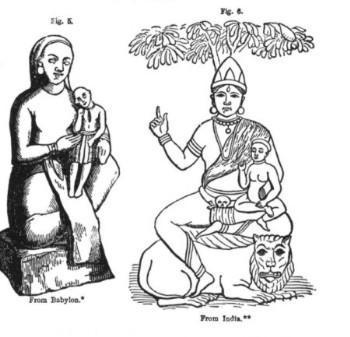
In Papal Italy, as travellers universally admit (except where the Gospel has recently entered), all appearance of worshipping the King Eternal and Invisible is almost extinct, while the Mother and the Child are the grand objects of worship. Exactly so, in this latter respect, also was it in ancient Babylon. The Babylonians, in their popular religion, supremely worshipped a Goddess Mother and a Son, who was represented in pictures and in images as an infant or child in his mother's arms. (see figures 5 and 6) From Babylon, this worship of the Mother and the Child spread to the ends of the earth. In Egypt, the Mother and the Child were worshipped under the names of Isis and Osiris. * In India, even to this day, as Isi and Iswara; ** in Asia, as Cybele and Deoius; in Pagan Rome, as Fortuna and Jupiter-puer, or Jupiter, the boy; in Greece, as Ceres, the Great Mother, with the babe at her breast, or as Irene, the goddess of Peace, with the boy Plutus in her arms; and even in Thibet, in China, and Japan, the Jesuit missionaries were astronished to find the counterpart of Madonna *** and her child as devoutly worshipped as in Papal Rome itself; Shing Moo, the Holy Mother in China, being represented with a child in her arms, and a glory around her, exactly as if a Roman Catholic artist had been employed to set her up. ****
* Osiris, as the child called most frequently Horus. BUNSEN.** KENNEDY'S Hindoo Mythology. Though Iswara is the husband of Isi, he is also represnted as an infant at her breast.
*** The very name by which the Italians commonly designate the Virgin, is just the translation of one of the titles of the Babylonian goddess. As Baal or Belus was the name of the great male divinity of Babylon, so the female divinity was called Beltis. (HESYCHIUS, Lexicon) This name has been found in Nineveh applied to the "Mother of the gods" (VAUX'S Nineveh and Persepolis); and in a speech attributed to Nebuchadnezzar, preserved in EUSEBII Proeparatio Evangelii, both titles "Belus and Beltis" are conjoined as the titles of the great Babylonian god and goddess. The Greek Belus, as representing the highest title of the Babylonian god, was undoubtedly Baal, "The Lord." Beltis, therefore, as the title of the female divinity, was equivalent to "Baalti," which, in English, is "My Lady," in Latin, "Mea Domina," and, in Italina, is corrupted into the well known "Madonna." In connection with this, it may be observed, that the name of Juno, the classical "Queen of Heaven," which, in Greek, was Hera, also signified "The Lady"; and that the peculiar title of Cybele or Rhea at Rome, was Domina or "The Lady." (OVID, Fasti) Further, there is strong reason to believe, that Athena, the well known name of Minerva at Athens, had the very same meaning. The Hebrew Adon, "The Lord," is, with the points, pronounced Athon. We have evidence that this name was known to the Asiatic Greeks, from whom idolatry, in a large measure, came into European Greece, as a name of God under the form of "Athan." Eustathius, in a note on the Periergesis of Dionysius, speaking of local names in the district of Laodicea, says the "Athan is god." The feminine of Athan, "The Lord," is Athan, "The Lady," which in the Attic dialect, is Athena. No doubt, Minerva is commonly represented as a virgin; but, for all that, we learn from Strabo that at Hierapytna in Crete (the coins of which city, says Muller, Dorians have the Athenian symbols of Minerva upon them), she was said to be the mother of the Corybantes by Helius, or "The Sun." It is certain that the Egyptian Minerva, who was the prototype of the Athenian goddess, was a mother, and was styled "Goddess Mother," or "Mother of the Gods."
**** CRABB'S Mythology. Gutzlaff thought that Shing Moo must have been borrowed from a Popish source; and there can be no doubt, that in the individual case to which he refers, the Pagan and the Christian stories had been amalgamated. But Sir. J. F. Davis shows that the Chinese of Canton find such an analogy between their own Pagan goddess Kuanyin and the Popish Madonna, that, in conversing with Europeans, they frequently call either of them indifferently by the same title. DAVIS' China. The first Jesuit missionaries to China also wrote home to Europe, that they found mention in the Chinese sacred books--books unequivocally Pagan--of a mother and child, very similar to their own Madonna and child at home.
One of the names of the Chinese Holy Mother is Ma Tsoopo; in regard to which, see note below.
Notes
Shing Moo and Ma Tsoopo of China
The name of Shing Moo, applied by the Chinese to their "Holy Mother," compared with another name of the same goddess in another province of China, strongly favours the conclusion that Shing Moo is just a synonym for one of the well known names of the goddess-mother of Babylon. Gillespie (in his Land of Sinim) states that the Chinese goddess-mother, or "Queen of Heaven," in the province of Fuh-kien, is worshipped by seafaring people under the name of Ma Tsoopo. Now, "Ama Tzupah" signifies the "Gazing Mother"; and there is much reason to believe that Shing Moo signifies the same; for Mu was one of the forms in which Mut or Maut, the name of the great mother, appeared in Egypt (BUNSEN'S Vocabulary); and Shngh, in Chaldee, signifies "to look" or "gaze." The Egyptian Mu or Maut was symbolised either by a vulture, or an eye surrounded by a vulture's wings (WILKINSON). The symbolic meaning of the vulture may be learned from the Scriptural expression: "There is a path which no fowl knoweth, and which the vulture's eye hath not seen" (Job 28:7). The vulture was noted for its sharp sight, and hence, the eye surrounded by the vulture's wings showed that, for some reason or other, the great mother of the gods in Egypt had been known as "The gazer." But the idea contained in the Egyptian symbol had evidently been borrowed from Chaldea; for Rheia, one of the most noted names of the Babylonian mother of the gods, is just the Chaldee form of the Hebrew Rhaah, which signifies at once "a gazing woman" and a "vulture." The Hebrew Rhaah itself is also, according to a dialectical variation, legitimately pronounced Rheah; and hence the name of the great goddess-mother of Assyria was sometimes Rhea, and sometimes Rheia. In Greece, the same idea was evidently attached to Athena or Minerva, whom we have seen to have been by some regarded as the Mother of the children of the sun. For one of her distinguishing titles was Ophthalmitis (SMITH'S Classical Dictionary, "Athena"), thereby pointing her out as the goddess of "the eye." It was no doubt to indicate the same thing that, as the Egyptian Maut wore a vulture on her head, so the Athenian Minerva was represented as wearing a helmet with two eyes, or eye-holes, in the front of the helmet. (VAUX'S Antiquities)
Having thus traced the gazing mother over the earth, is it asked, What can have given origin to such a name as applied to the mother of the gods? A fragment of Sanchuniathon, in regard to the Phoenician mythology, furnishes us with a satisfactory reply. There it is said that Rheia conceived by Kronos, who was her own brother, and yet was known as the father of the gods, and in consequence brought forth a son who was called Muth, that is, as Philo-Byblius correctly interprets the word, "Death." As Sanchuniathon expressly distinguishes this "father of the gods" from "Hypsistos," The Most High, * we naturally recall what Hesiod says in regard to his Kronos, the father of the gods, who, for a certain wicked deed, was called Titan, and cast down to hell. (Theogonia)
* In reading Sanchuniathon, it is necessary to bear in mind what Philo-Byblius, his translator, states at the end of the Phenician History--viz., that history and mythology were mingled together in that work.
The Kronos to whom Hesiod refers is evidently at bottom a different Kronos from the human father of the gods, or Nimrod, whose history occupies so large a place in this work. He is plainly none other than Satan himself; the name Titan, or Teitan, as it is sometimes given, being, as we have elsewhere concluded, only the Chaldee form of Sheitan, the common name of the grand Adversary among the Arabs, in the very region where the Chaldean Mysteries were originally concocted,--that Adversary who was ultimately the real father of all the Pagan gods,--and who (to make the title of Kronos, "the Horned One," appropriate to him also) was symbolised by the Kerastes, or Horned serpent. All "the brethren" of this father of the gods, who were implicated in his rebellion against his own father, the "God of Heaven," were equally called by the "reproachful" name "Titans"; but, inasmuch as he was the ringleader in the rebellion, he was, of course, Titan by way of eminence. In this rebellion of Titan, the goddess of the earth was concerned, and the result was that (removing the figure under which Hesiod has hid the fact) it became naturally impossible that the God of Heaven should have children upon earth--a plain allusion to the Fall.
Now, assuming that this is the "Father of the gods," by whom Rhea, whose common title is that of the Mother of the gods, and who is also identified with Ge, or the Earth-goddess, had the child called Muth, or Death, who could this "Mother of the gods" be, but just our Mother Eve? And the name Rhea, or "The Gazer," bestowed on her, is wondrously significant. It was as "the gazer" that the mother of mankind conceived by Satan, and brought forth that deadly birth, under which the world has hitherto groaned. It was through her eyes that the fatal connection was first formed between her and the grand Adversary, under the form of a serpent, whose name, Nahash, or Nachash, as it stands in the Hebrew of the Old Testament, also signifies "to view attentively," or "to gaze" (Gen 3:6) "And when the woman saw that the tree was good for food, and pleasant to the eyes," &c., "she took of the fruit thereof, and did eat; and gave also unto her husband with her, and he did eat." Here, then, we have the pedigree of sin and death; "Lust, when it had conceived, brought forth sin; and sin, when it was finished, brought forth death" (James 1:15).
Though Muth, or Death, was the son of Rhea, this progeny of hers came to be regarded, not as Death in the abstract, but as the god of death; therefore, says Philo-Byblius, Muth was interpreted not only as death, but as Pluto. (SANCHUN) In the Roman mythology, Pluto was regarded as on a level, for honour, with Jupiter (OVID, Fasti); and in Egypt, we have evidence that Osiris, "the seed of the woman," was the "Lord of heaven," and king of hell, or "Pluto" (WILKINSON; BUNSEN); and it can be shown by a large induction of particulars (and the reader has somewhat of the evidence presented in this volume), that he was none other than the Devil himself, supposed to have become incarnate; who, though through the first transgression, and his connection with the woman, he had brought sin and death into the world, had, nevertheless, by means of them, brought innumerable benefits to mankind. As the name Pluto has the very same meaning as Saturn, "The hidden one," so, whatever other aspect this name had, as applied to the father of the gods, it is to Satan, the Hidden Lord of hell, ultimately that all came at last to be traced back; for the different myths about Saturn, when carefully examined, show that he was at once the Devil, the father of all sin and idolatry, who hid himself under the disguise of the serpent,--and Adam, who hid himself among the trees of the garden,--and Noah, who lay hid for a whole year in the ark,--and Nimrod, who was hid in the secrecy of the Babylonian Mysteries.
It was to glorify Nimrod that the whole Chaldean system of iniquity was formed. He was known as Nin, "the son," and his wife as Rhea, who was called Ammas, "The Mother." The name Rhea, as applied to Semiramis, had another meaning from what it had when applied to her, who was really the primeval goddess, the "mother of gods and men." But yet, to make out the full majesty of her character, it was necessary that she should be identified with that primeval goddess; and, therefore, although the son she bore in her arms was represented as he who was born to destroy death, yet she was often represented with the very symbols of her who brought death into the world. And so was it also in the different countries where the Babylonian system spread.