App
App
Christian Biblical Church of God
Post Office Box 1442
Hollister, California 95024-1442
(831)-637-1875
Fred R. Coulter, Minister
May 24, 2004
Dear Brethren,
The month of May has been extremely busy. For the first Sabbath of the month I traveled to Manchester, New Hampshire. We sent out the announcement letter and were expecting 32-35 brethren to show up at the downtown Radisson Hotel, but 58 came—12 from Canada. We overfilled the meeting room, and they had to open up the room to accommodate everyone.
It was wonderful to see all the brethren and to talk with them, and the fellowship was great. We had an excellent meal between the morning and afternoon services. Then, after finishing the second sermon, the brethren wanted to have a Bible Study as well. It turned out to be a tremendous Sabbath. We all left inspired and uplifted.
Elders' Conference: An Elders' Conference was held in Cincinnati, Ohio, May 14-16. The main theme of the conference was how to reach new people. We realize that one of the mistakes churches tend to make when trying to reach new people is that they try to "church" the "unchurched." When churches seek to do this, they often water down the Word of God. However, God commands that repentance of sins and remission of sins through Jesus Christ be preached, as Jesus commanded: "According as it is written, it was necessary for the Christ to suffer, and to rise from the dead the third day. And in His name, repentance and remission of sins should be preached to all nations, beginning at Jerusalem" (Luke 24:46-47). Matthew also recorded Jesus' command: " 'All authority in heaven and on earth has been given to Me. Therefore, go and make disciples in all nations, baptizing them into the name of the Father, and of the Son, and of the Holy Spirit; teaching them to observe all things that I have commanded you. And lo, I am with you always, even until the completion of the age.' Amen" (Matt. 28:18-20).
When Jesus began His ministry in Galilee, He proclaimed repentance. "Now after the imprisonment of John, Jesus came into Galilee, proclaiming the gospel of the kingdom of God, and saying, The time has been fulfilled, and the kingdom of God has drawn near; repent, and believe in the gospel' " (Mark 1:14-15).
On the day of Pentecost, with the outpouring of the Holy Spirit, Peter called the people to account for killing Jesus Christ and preached repentance: " Therefore, let all the house of Israel know with full assurance that God has made this same Jesus, Whom you crucified, both Lord and Christ.' Now after hearing this, they were cut to the heart; and they said to Peter and the other apostles, 'Men and brethren, what shall we do?' Then Peter said to them, 'Repent and be baptized each one of you in the name of Jesus Christ for the remission of sins, and you yourselves shall receive the gift of the Holy Spirit. For the promise is to you and to your children, and to all those who are afar off, as many as the Lord our God may call.' And with many other words he earnestly testified and exhorted, saying, 'Be saved from this perverse generation.' Then those who joyfully received his message were baptized; and about three thousand souls were added that day" (Acts 3:36-41).
We know that the Father must draw unbelievers to Jesus Christ (John 6:44). God must lead them to repentance (Rom 2:4). The word of God must be preached (II Tim. 4:1-4). However, God the Father and Jesus Christ have always used men to participate in this work. Paul wrote: "How then shall they call on Him in Whom they have not believed? And how shall they believe in Him of Whom they have not heard? And how shall they hear without preaching? And how shall they preach, unless they be sent? Accordingly, it is written, 'How beautiful are the feet of those who announce the gospel of peace, and those who announce the good news of good things!' " (Rom. 10:14-15).
The New Testament shows that we, the people of God, must be ready and must prepare ourselves to preach God's message of repentance. Otherwise, how can we reach the people that God wants us to reach? This means that we have to develop the means and materials that are relevant for today, which will help new people to answer God's call to repentance. One big asset we already have is the CBCG web site.
We are already serving thousands of new people through our web site, which is running 24 hours a day seven days a week and is available around the world. Nearly 10,000 people use the web site every month. That is a small start— but it is a start. We have had at least a half dozen baptisms because of it. We intend to make it easier for people to find the web site. We will do this by adding the web site Church at Home where we will place materials for new people. This will be a feeder site to our regular church web site. Also, we will have an additional feeder web site, Biblical Truth Ministries. This site will preach the Truth of the Word of God and expose the lies from the pulpits of the churches of this world. This one should be up and running in about a month. It will feature a listing, "Lies From the Pulpit." Both of these new sites will help reach more people.
Our prayers are that God the Father and Jesus Christ will lead us to do His will in reaching new people. We also realize that many times the brethren who are already in the church are neglected by the ministry in the church's effort to reach new people. This is a mistake. We will continue to "feed the flock" and "perfect the saints" as we are commanded and have been doing. Also, the brethren will continue to reach out to other brethren who have become disillusioned with other churches of God.
On Sabbath during the Elders' Conference, May 15, over 100 brethren attended morning and afternoon services, and we had an excellent meal between services. We are sending you the sermon on reaching new people that I gave in Cincinnati, which is also a summary of the Elders' Conference.
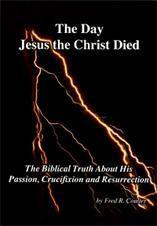
The New Book: We have finished the new book The Day Jesus the Christ Died—The Biblical Truth About His Passion, Crucifixion and Resurrection. Some of the material in this book has been taken from The Harmony and some from The Christian Passover. But, a lot of new material has been added to give the complete biblical account. We sent it to the printer May 19. It is scheduled to be finished in about four weeks. It will have a soft cover and will be 7" x 10" in size, with 170 pages. The front cover has a dramatic picture of lightening bolts.
This is the first book we have produced that is geared to new people. Because millions of people have seen Mel Gibson's movie The Passion of the Christ, people are not afraid or embarrassed to talk about it. This gives all of us the opportunity to give the new book to anyone who is interested.
On the back cover there is a description of the book that is most challenging—designed to cause people to desire to read the book:
"Mel Gibson's epic movie, The Passion of the Christ, has shocked its audience with stark realism and bloody brutality—a powerful emotional presentation! As gripping and controversial as it was, the millions who experienced the movie did not realize that it was a combination of the Gospel accounts, tradition, mysticism and artistic license—telling less than half of the story.
"Completely absent from Gibson's account was any mention of the name or meaning of the day Jesus was crucified. Yet, that Day of Destiny is the central theme and purpose of the entire Bible and God's plan of salvation for mankind. In fact, the day Jesus the Christ died was planned and predetermined before the creation of the world!
"If you believe that Gibson's portrayal of the suffering and crucifixion of Christ accurately represents the Scriptures, then you need to read the full account contained in this book.
"The day Jesus the Christ Died—the Biblical Truth About His Passion, Crucifixion and Resurrection" is THE ONLY BOOK to present "the rest of the story"—the whole truth and nothing but the truth!
"Without the true historical and Biblical facts, no one can fully understand the real meaning of Jesus Christ's horrific, humiliating and gruesome death by beating, scourging and crucifixion.
"The author, Fred R. Coulter, presents the full biblical account in a most compelling way. As you will see, the truth is more astounding and profound than all the ideas, superstitions, traditions and misbeliefs of men!"
We will be mailing the new book before the end of June. We hope that you will like it and will use it to reach out to new people.
Another Book Exposes the Problems of Modern Translations: A book written by Leland Ryken, The Word of God in English—Criteria for Excellence in Bible Translation, compares many modern English translations and exposes their fundamental errors. Ryken shows that the translators have produced versions that greatly distort and change the Bible so that it is, in fact, no longer the Word of God. This is because the translators did not render a word-for-word translation of the corrupted Greek texts that they used for their translations. They used a translation method called "dynamic equivalence." This means that with most modern versions we are confronted with two fundamental errors: The wrong Hebrew and Greek texts and flawed methods of translating that do not convey the true meaning of the original text.
The Flawed Translation Practices: Today, too many translators are not actually translating; rather, they are interpreting what they think the writer was thinking or intending to write at the time he wrote it. This method of translation is utterly absurd! How can a translator today, thousands of years removed, presume to know what the writer was thinking or intending to write when he wrote the text? It is impossible! When the writer wrote the words that became the text, he expressed his thoughts in those words. He wrote what he was thinking or what he was inspired or commanded by God to write. Therefore, the written words of the biblical Hebrew and Greek need to be translated accurately, faithfully and truthfully because they are the words of God.
Leland Ryken wrote a great deal about this dynamic equivalent method of translating the Bible, exposing the fundamental errors of such translations: "No principle has been more central to the dynamic equivalent project than the claim that translators should translate the meaning or ideas rather than the words of the original....When these translations claim to give 'the meaning of the original' (GNB) or 'the thought of the biblical writers' (NIV), they signal that the translators were committed to translating what they interpret the meaning of the original to be instead of first of all preserving the language of the original. The premise is that 'a thought-for-thought translation ... has the potential to represent the intended meaning of the original text even more accurately than a word-for-word translation' (NLT).
"The fallacy of thinking that a translation should translate the meaning rather than the words of the original is simple: There is no such a thing as disembodied thought, emancipated from words. Ideas and thoughts depend on words and are expressed by them. When we change the words, we change the meaning ... The whole dynamic equivalent project is based on an impossibility and a misconception about the relationship between words and meaning. Someone has accurately said that 'the word may be regarded as the body of the thought,' adding that 'if words are taken from us, the exact meaning is of itself lost.'
"When the words differ, the meaning differs. To claim that we can translate ideas instead of words is an impossibility" (Ryken, pp. 79-81, bold emphasis added).
Ryken rightly points out that a translator is only a steward of God's word: "For essentially literal translators, the translator is a messenger who bears someone else's message and 'a steward of the work of another' whose function is 'to be faithful to what is before him' and 'not ... to change the text.' Dynamic equivalent translators assume the roles of both exegete and editor. In those roles, they perform exactly the same functions that exegetes and editors perform—they offer interpretations of the biblical text right in the translation, and they make stylistic changes that they think will improve the biblical text for a target audience" (Ibid., p. 91).
Furthermore, Ryken points out the fallacy of making readability the ultimate goal of translation while sacrificing truth: "Because dynamic equivalence has dominated the field for half a century, the criterion of readability (code language for 'easy to read') has become the chief selling point for modern translations....Having had a quarter of a century to ponder the matter, I have concluded that the criterion of readability, when offered as a criterion by itself, should be met with the utmost resistance. To put it bluntly, what good is readability if a translation does not accurately render what the Bible actually says? If a translation gains readability by departing from the original, readability is harmful. It is, after all, the truth of the Bible that we want" (Ibid., p.91, bold emphasis added).
Being truthful and faithful to the original is the key to excellence in an English translation because "The only legitimate appeal to readability comes within the confines of a translation's having been truthful to the language of the original. Faithfulness to what the Bible actually says is like a qualifying exam. If a translation does not give us that, it has failed the test, and we can be excused from inquiring into its readability. Within the confines of accuracy to the original text, a translation should strive to achieve maximum readability by avoiding obsolete words and demonstrably archaic language, and by using with discretion and where necessary words that are slightly archaic and words in a reader's passive as distinct from active vocabulary (words that are understood by readers though not regularly used by them)" (Ibid., p. 92, bold emphasis added).
As Ryken points out, it is a fallacy to translate the Bible on the basis of how we would say something or how the Bible writers would express something if they were living today. Of this he wrote: "Once again we need to state the obvious: The biblical writers are not writing today, They wrote millennia ago. To picture them as writing in an era when they did not write is to engage in fiction, and it distorts the facts of the situation.
"The real objective to claming to know how a biblical writer would have expressed himself if he were writing today is that it is totally speculative. There is no verifiable way by which we can know how biblical writers would express themselves if they were writing today. In my experience it is invariably translators who want to produce a colloquial Bible expressed in a contemporary English idiom who propose to know how biblical writers would have expressed themselves if they were living today. To engage in such speculation is to remake the Bible in our own image....It is pure speculation how Paul would have expressed himself if he were speaking and writing today. We do not know how he would have expressed himself in modern terms. We do not want a speculative Bible. We need a Bible based on certainty. What is certain is what the biblical writers did actually say and write" (Ibid., pp. 98-99, bold emphasis added). Ryken summarizes what makes the best Bible translation as follows:
1) Accuracy
2) Fidelity to the words of the original
3) Effective diction
4) Theological orthodoxy
5) Preserving multiple meanings
6) The full exegetical potential of the original text
7) Expecting the best from the readers
8) Transparency to the original world of the Bible
9) What you see is what you get
10) Respect for the principles of poetry
11) Excellence of rhythm
12)Dignity and beauty" (Ibid., 289-293).
In his conclusion Ryken writes: "English Bible translation has lost its way in the past half century. We are further from having a reliable and stable text than ever before. The only Bible reader who is not perplexed is the one who sticks with just one version and does not inquire any more broadly into what is going on. English Bible readers deserve a translation that they can trust and admire because it represents standards of excellence and dignity" (Ibid., p. 293, bold emphasis added).
The Wrong Greek Text of the New Testament: Nearly all the modern translations of the Bible, such as the GNB, NIV, NEB, NLT, NASB and The Inclusive Version, The Message—In Contemporary English, have been translated from corrupt Greek texts—eclectic versions—or the combining of various spurious texts. After over one hundred years of scholarly and textual research, these deficient, corrupt texts have now been shown not to be the true text of the New Testament. Rather, the very text that was rejected, beginning with Wescott and Hort in the 1880's, has now been proven to be true text of the New Testament that God has preserved for us today. That Greek text is the Textus Receptus—the very text that I used to translate the New Testament—Stephens 1550 Greek Text.
A Call for a Return to the Textus Receptus Greek Text: Because of this, there is a strong movement and demand, even by scholars, for a return to the more accurate Textus Receptus Greek text. In his book, The Ancient Text of the New Testament, Dr. Jakob Van Bruggen shows why the Alexandrian type texts are inferior and should be rejected as the basis for translating the New Testament. After more than a century of using these texts for translation, he is calling for a return to the Byzantine Greek text known as the Textus Receptus—Stephens 1550 edition and similar Greek texts in the Textus Receptus family that were used during the Reformation. In his concluding remarks, Van Bruggen calls for a rehabilitation of the ancient text which he calls the Church text: "There is, therefore, every reason to rehabilitate the Church text again. It has already been accepted for centuries and centuries by the Greek Church as the ancient and correct text. Its right does not have to be proven. The person who thinks he knows better than those who preserved and transmitted the text in the past should come along with proof. The churches of the great Reformation deliberately adopted this ancient text when they took the Greek text as starting-point again. This text deserves to remain recognized as reliable, unless real contra-proof can be given from a recovered better text. However, there are no better texts ... we plead for rehabilitation of the ancient and well-known text. This means that we do not dismiss this text which is found in a large majority of the textual witnesses and which underlies all the time-honored Bible translations of the past, but [that we] prize and use it" (page 36).
Van Bruggen's call for the rehabilitation of the Textus Receptus begins with new translations and the casting aside of the United Bible Societies eclectic "Majority Text" that was created by subjective scholarly opinions and guesses: "The examination of the modern textual criticism and the readings it defends should, however, not stand in the service of eclecticism whereby the Byzantine text is only accepted as one of the sources for optional-readings. Eclecticism is always a subjective matter and only creates new mixed [false] texts. The criteria of eclecticism also contradict each other. Now that there is considerable agreement concerning the texts exists in the broad stream of the text-tradition, there is no need to resort to eclecticism. Copies of a corrupt text-form in the 2nd century, accidentally saved, would then receive a place equal to that of copies from many other centuries which are generally accepted as faithful copies [which is not correct]" (Ibid., p. 38, bracketed comments added).
"The rehabilitation of the received text should, in the churches of the Reformation, result in putting this text into use again, and that first of all for Bible-translation. Translations which go back to the Byzantine text do not need to be old translations ... But the newest translation should still give access to the text of the Church of the ages and not to the text of five learned contemporaries in the 20th century. The Greek New Testament of the United Bible Societies should as a basis for translations of the New Testament be exchanged for an edition of the Textus Receptus ..." (Ibid., p. 38).
Brethren, I did not have these books until Gary Staszak gave them to me at the Elders' Conference. I did not know that Van Bruggen and other honest scholars were calling for a return to the Textus Receptus, but that is the very Greek New Testament that I used. Furthermore, all during the translation of the New Testament and the writing of the commentaries, we endeavored to meet all the criterion that Ryken demonstrated was necessary, though we never had a list of them. My main goal was to have an accurate and truthful translation of the New Testament as it was inspired and preserved by God. The final result was that The New Testament In Its Original Order—A Faithful Version With Commentary is as faithful and literal a translation as is possible from the original Greek, written by the Apostles of God and preserved in the Byzantine text. All during the translation of the New Testament and the writing of the commentaries, we looked to God to inspire us and to guide us so that the final product would be faithful to God the Father, Jesus Christ and the inspired Greek New Testament.
We used the Word of God as our guide, knowing that what the apostles wrote was inspired by the Holy Spirit. Yes, "God-breathed" as Paul wrote: "All Scripture is God-breathed and is profitable for doctrine, for conviction, for correction, for instruction in righteousness" (II Tim 3:16). First and foremost, we also kept in mind what Peter wrote concerning the Old and New Testament writings: "Knowing this first, that no prophecy of Scripture originated as anyone's own private interpretation; because prophecy was not brought at any time by human will, but the holy men of God spoke as they were moved by the Holy Spirit" (II Pet. 1:20-21).
We can all thank God the Father and Jesus Christ that this Faithful Version translated from the Stephens 1550 Greek text meets all the criterion for "excellence" in an English translation, as Leland Ryken outlines in his book. As a result, we have, thanks to God the Father and Jesus Christ, a New Testament that is actually on the cutting edge of excellence in Bible translation.
Almost Out of New Testaments: What a demand we have had for the New Testament! Of the 5,000 from the first printing, we have less than 400 left. It appears that they will be gone by the middle of July or sooner. In preparation for the second printing, we are cleaning up the few typos that slipped through in the first printing.
CD Production Snag: We have been running a pilot program for producing CD's instead of audiocassette tapes. However, we have run into some major technical snags to go to full-time production. It will take us some time to resolve them. We are putting the project on hold until they are resolved. We will, however, continue with our limited pilot program.
Pentecost Tape: We have mailed out the tapes for Day 49 and Pentecost. However, on the label of the Pentecost tape I wrote the wrong date. I incorrectly wrote May 31 instead of May 30. We hope that this did not cause you any confusion.
We hope and pray that God will bless you with an inspiring Day of Pentecost. The church is the first fruit harvest of God the Father and Jesus Christ. Remember Pentecost pictures the first fruit harvest—the first resurrection. The Feast of Trumpets is not a harvest feast and does not picture the resurrection, though we falsely assumed that in years past. We hope that at this time you understand the difference. If not, you will understand in the future as you study about Pentecost. As one person said, "When I first heard that Pentecost pictured the first resurrection, it made sense to me, but it took me several years to understand it more completely." We have many tapes from past years that further explain the difference. If you would like those, please order them.
Brethren, thank you for your love, prayers for reaching out to brethren who need help and also to new people. Thank you for your continued support through your tithes and offerings. May God the Father and Jesus Christ continue to bless you with Their love, grace and blessings in all things.
With love in Christ Jesus
Fred R. Coulter
FRC
P.S. The Feast Letter will be coming soon. It will list all the places where we will be holding the Feast of Tabernacles this year.