App
App
Christian Biblical Church of God
Post Office Box 1442
Hollister, California 95024-1442
(831)-637-1875
Fred R. Coulter
Minister
March 13, 2008
Dear Brethren,
While in Scottsdale, Arizona, for Sabbath services on December 13, I talked with a woman who wanted to be baptized. Her husband had been baptized many years ago. Since I was returning home that evening, I was unable to baptize her at that time. After learning that she and her husband lived near Las Vegas, Nevada, I promised to make a special trip in February to baptize her.
In preparing for the trip I checked our mailing list, and was surprised to find that there were ten people near Las Vegas who were receiving our materials. We contacted each one to inform them that I was coming up and that I would be holding a Bible Study. One family that attended the study had just moved their home and business to that area because of rising costs and taxes in California. I flew up to Las Vegas on Wednesday, February 27, and we had a Bible Study with eight in attendance. The whole day was very inspiring. Later that afternoon I baptized the woman I’d met in Scottsdale in December.
As in February, I will be traveling a great deal in March. This past Sabbath, March 8, I went to Arcadia for Sabbath services where we had 45 in attendance. The morning study concerning questions about the Passover—and in particular the differences between the Passover instructions of Exodus 12 and those of Deuteronomy 16.
In the afternoon, I gave a sermon on the sacrifice of Jesus Christ as our Passover Lamb—which God the Father and God the Son had planned before the foundation of the world. We will include both of these studies in our next mailing. Later this month, March 21-23, I will be traveling to Seattle and Spokane, Washington.
Although we are a month and a half from the Passover and Feast of Unleavened Bread, I will be bringing some vital studies on these subjects so that we may all be spiritually prepared for the most important day in the history of the universe—the day Jesus the Christ died.
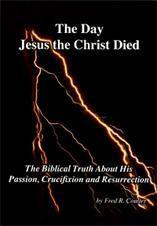
As with last year, right after the Feast of Tabernacles we began offering Occult Holidays or God’s Holy Days—Which? on our Web site. Then, at the end of January, we began offering The Day Jesus the Christ Died. We have had an excellent response to both offers and are able to send the books out at no cost to those who request them. So far, we’ve mailed out over 2,000 Occult Holidays books and 1,200 copies of The Day Jesus the Christ Died. We plan to continue the ad for The Day Jesus the Christ Died through Passover and Unleavened Bread.
We are currently having 7,000 copies of The Day Jesus the Christ Died reprinted with all the Old Testament Scriptures updated to conform to the coming new Bible. This is our 4th printing, making a total of 15,000 copies that we have sent out in the past four years. We know that God is blessing our efforts. We are reaching many brethren and new people all the time, and receive between 35,000 to 40,000 visits each month to our Web sites. God promises: “Cast your bread upon the waters; for you shall find it after many days…. For as the rain comes down, and the snow from the heavens, and does not return there, but waters the earth, and makes it bring forth and bud, and gives seed to the sower and bread to the eater; so shall My Word be, which goes out of My mouth; it shall not return to Me void, but it shall accomplish what I please, and it shall certainly do what I sent it to do” (Eccl. 11:1; Isa. 55:10-11).
Also, we are nearly out of the Occult Holidays book. But before we reprint it we are updating the OT Scriptures and adding a great deal of new material showing how the occult is truly sweeping the world, under Satan’s deception, to prepare all nations for the coming beast and false prophet of Revelation 13. At the present time, we are close to or perhaps past the tipping point where the whole world will be led into the open worship of Satan: “[T]he ancient serpent who is called the Devil and Satan, who is deceiving the whole world…. And they worshiped the dragon, who gave his authority to the beast. And they worshiped the beast, saying, ‘Who is like the beast? Who has the power to make war against him?’ And a mouth speaking great things and blasphemies was given to him; and authority was given to him to continue for forty-two months” (Rev. 12:9; 13:4-5).
Finally, to make the updated version even more complete, we are adding a special appendix, “Understanding Paul’s Hard-to-Understand Scriptures.” When finished, we will send everyone on the mailing list a copy of the new version.
The Bible Project: By now, the new Bible has been printed, and the first sample copies should be on their way to Hollister. The tentative schedule is to have all 10,000 Bibles finished by March 20, and then shipped via container ship to the port of Oakland. (We will have the Bibles for Australia, New Zealand and South Africa sent directly to them). The Bibles should arrive about four weeks later, and we will immediately begin mailing them out according to the number ordered. This means that you should receive your new Bible(s) by the middle of May.
We have included in this mailing two booklets. The first, Count to Pentecost—the Morrow After Which Sabbath?, is most important this year because the Passover falls on a weekly Sabbath. This means that the first holy day is on the first day of the week and the last holy day is on the weekly Sabbath. Since there is no weekly Sabbath between the two holy days, how is the count for Pentecost figured? This booklet answers that question. The second booklet features recipes for the Feast of Unleavened Bread.
What is the True Meaning of Our Liberty in Christ?
Vital to our study of “Can a Man or Woman be in Right Standing with God?”, we need to realize that virtually none of the Protestant teachers or their followers understand the true meaning of a true believer’s “liberty in Christ Jesus.” They falsely assume that “liberty in Christ” means they do not have to keep the laws and commandments of God. But most specifically, they apply this to Sabbath and holy day observance.
They often quote what the apostle Paul wrote in Galatians 5:1. “Therefore, stand fast in the liberty wherewith Christ has made us free, and do not be held again in a yoke of bondage.” Based on the “liberty” they claim to have in Christ, they assume they are free to keep Sunday, Christmas, Easter and other holidays of the world—and that they are not obligated to observe the Sabbath and holy days.
They assume that because we are under grace, Christians do not have to keep the laws and commandments of God. They believe the laws and commandments of God are the “yoke of bondage” to which Paul referred. In other words, “liberty in Christ” is wrongly declared to be “liberty” or “freedom” from law-keeping. This confusion is the result of not understanding the true Scriptural meaning of “justification” and “grace.”
First, let us understand what justification is: Justification is freely granted to the called and repentant believer by God the Father through the sacrifice of Jesus Christ. Justification takes place when the believer’s past sins are removed by the blood of Jesus Christ and he or she is put into right standing with God the Father. In order to receive God’s gift of justification, a person must repent toward God, believe in the sacrifice and blood of Jesus Christ for the remission of sins, and be baptized by immersion. The believer is then cleansed from past sins and is without condemnation, placing him or her in right standing with God the Father. This state of justification is called the “gift of righteousness,” because the righteousness of Jesus Christ is freely imputed to the believer by God the Father. The English word “justification” comes from the Greek word dikaioosis, which means “the action of God which establishes right, thus justification.” Justification, then, is the establishment of a person as “just” before God by being acquitted from the “guilt of sin.”
Justification comes through the death and resurrection of Jesus Christ. If Christ was not raised from the dead, we would all still be in our sins. There would be no forgiveness, nor justification. Paul made this clear in his first epistle to the Corinthians: “Now then, if Christ be preached, that He rose from the dead, how is it that some among you are saying that there is not a resurrection of the dead? But if there is not a resurrection from the dead, neither has Christ been raised.
“And if Christ has not been raised, then our preaching is without truth and your faith is also void. And we are also found to be false witnesses for God; because we have testified of God that He raised Christ, Whom He did not raise, if indeed the dead are not raised. For if the dead are not raised, neither has Christ been raised; now if Christ has not been raised, then your faith is vain you are still in your sins.
“And those who have fallen asleep in Christ have perished. If in this life we only have hope in Christ, we are of all people most miserable. But now, Christ has been raised from the dead. He became the firstfruit of those who have fallen asleep” (I Cor. 15:12-20, AT).
But Christ was raised from the dead so that we may be justified and put into right standing with God the Father. Paul also shows that faith and belief are required as well for God to impute righteousness to us: “And he [Abraham] was fully persuaded that what He had promised, He is also able to do. As a result, it was also imputed to him for righteousness. But it was not written for his sake alone, that it was imputed to him; rather, it was also written for our sake, to whom it shall be imputed—to those who believe in Him Who raised Jesus our Lord from the dead, Who was delivered for our offenses, and WAS RAISED FOR OUR JUSTIFICATION” (Rom. 4:21-25).
Once we have been justified to God the Father through the death and resurrection of Jesus Christ—having our sins forgiven by faith in Jesus Christ—we are under the grace of God. Let us understand the true meaning of “grace.”
Grace as defined in the New Testament comes from the Greek word charis, which means “favor, grace, gracious help or care, goodwill, the gracious intention of God or gift; the practical application of goodwill, a favor, gracious deed or benefaction, a store of grace, a state of grace, a deed of grace and a work of grace; to be grateful, gratitude or thanks.” Moreover, grace denotes the state of the relationship between God and the believer through Jesus Christ. When Paul uses the word “grace” as part of an opening greeting or closing salutation, it is used to confer “divine grace” upon the one who is reading the epistle.
Grace is the free and undeserved gift of God the Father through Jesus Christ. The grace of God is the greatest expression of God the Father’s love and all-encompassing mercy. Grace is more than the forgiveness of sins. To be “under grace” means to continually be receiving God’s divine love, favor, blessing, gracious care, help, goodwill, benefits, gifts and goodness. God the Father is the source from which grace comes to the believer. Furthermore, the ONLY MEANS by which grace is granted to the believer is through the birth, life, crucifixion, death and resurrection of Jesus Christ as the perfect sacrifice of God the Father. The believer enters into the grace of God through faith in the sacrifice of Jesus Christ for the forgiveness of his or her sins. God the Father grants His grace to each believer upon repentance of sins and baptism by immersion, which is our covenant death into Christ’s death and is the outward manifestation of our repentance. Through grace, the believer’s sins are forgiven and the righteousness of Jesus Christ is imputed to him or her.
Grace establishes a new spiritual relationship between the believer and God the Father and Jesus Christ. Through the unearned and unmerited gift of grace, the believer is not only called, chosen, forgiven and accepted by God the Father through His Beloved, but is also begotten with the Holy Spirit, making him or her a child of God and an heir of eternal life. From this point forward, the spiritually begotten believer begins a new life under grace. As the Scriptures reveal, living under grace requires the believer to live by every word of God with complete love and devotion to God the Father and Jesus Christ. Grace does not grant one license to practice sin by ignoring or rejecting the commandments of God. Only those who keep His commandments can abide in His love and remain under His grace. Every believer who receives the grace of God has a personal obligation to God the Father and Jesus Christ to forsake his or her old, sinful thoughts and practices and to live a new life, daily growing in the grace and knowledge of Jesus Christ. For every believer who lives under grace, Jesus Christ acts as Redeemer, High Priest and Advocate. If the believer commits a sin, He intercedes to propitiate the Father and to obtain His mercy and grace.
In his first epistle, the apostle John wrote about this continuous process of mercy and grace that comes through our fellowship with God the Father and Jesus Christ, and by practicing the truth of God: “If we proclaim that we have fellowship with Him, but we are walking in the darkness, we are lying to ourselves, and we are not practicing the Truth. However, if we walk in the light, as He is in the light, then we have fellowship with one another, and the blood of Jesus Christ, His own Son, cleanses us from all sin. If we say that we do not have sin, we are deceiving ourselves, and the truth is not in us. If we confess our own sins [to God the Father through prayerful repentance], He is faithful and righteous, to forgive us our sins, and to cleanse us from all unrighteousness. If we say that we have not sinned, we make Him a liar, and His Word is not in us. My little children, I am writing these things to you so that you may not sin. And yet, if anyone does sin, we have an Advocate with the Father; Jesus Christ the Righteous; and He is the propitiation [a continuing source of mercy and forgiveness] for our sins” (I John 1:6-2:2).
Thus, the grace of God which comes through Jesus Christ keeps the repentant believer in a continual state of blamelessness and sinlessness.
As you can see, grace does not give anyone license, or liberty, to sin. Notice what Paul wrote concerning grace and sin. He made it absolutely clear that “grace” is not license to sin: “What then shall we say? Shall we continue in sin, so that grace may abound? MAY IT NEVER BE! We who died to sin, how shall we live any longer therein?” (Rom. 6:1-2). We can see that God has not given us liberty to live in sin—to transgress the laws and commandments of God. Rather, through Jesus Christ we have liberty or freedom from sin—we are free from the curses and penalties that come from living in sin! We most certainly do not have liberty or freedom to live in lawlessness—as does the world.
Consequently, when we are free from sin, we are to live in righteousness—we are to keep His commandments and walk as Jesus Himself walked. John makes this very clear: “And by this standard we know that we know Him: if we keep His commandments. The one who says, ‘I know Him,’ and does not keep His commandments, is a liar, and the truth is not in him. On the other hand, if anyone is keeping His Word, truly in this one the love of God is being perfected. By this means we know that we are in Him. Anyone who claims to dwell in Him is obligating himself also to walk even as He Himself walked” ( I John 2:4-6).
The truth is that law is established through faith and grace. Faith and grace are not “at odds” with law, and do not abolished law: “Are we, then, abolishing law through faith? MAY IT NEVER BE! Rather, we are establishing law [or making the law to stand]!” (Rom. 3:31).
Why and how is law being established by faith through justification, and grace through faith in Christ Jesus? Under the New Covenant, the laws and commandments of God are being written into our hearts and minds. “For by one offering [the sacrifice of Himself] He has obtained eternal perfection for those who are sanctified. And the Holy Spirit is also bearing witness to us; for after He had previously said, ‘This is the covenant that I will covenant with them after those days, says the Lord: I will give My laws into their hearts, and I will inscribe them in their minds; and their sins and lawlessness I will not remember ever again’ ” (Heb. 10:14-17).
As a result, through faith, the true believer stands in the grace of God through the justification which was achieved by the resurrection of Jesus Christ: “Therefore, having been justified by faith [in the death and resurrection of Jesus Christ], we have peace with God through our Lord Jesus Christ; through Whom also we now have the access by faith into this grace in which we stand, and we ourselves boast in the hope of the glory of God. And not only this, but now we also boast in tribulations; realizing that tribulation brings forth endurance, and the endurance brings forth character, and the character brings forth hope. Now the hope of God never makes us ashamed, because the love of God has been poured out into our own hearts through the Holy Spirit which has been given to us” (Rom. 5:1-5).
Then the gift of righteousness is imputed to us. God the Father imputes this gift of righteousness, the very righteousness of Jesus Christ, so that we may keep His commandments by the power of the Holy Spirit. We are no longer under the sentence of death, caused by our sins and transgressions, and we have been raised into a new way of life in Christ Jesus to live in righteousness, which leads to eternal life: “For if by the offense of one man death reigned by the one, how much more shall those who receive the abundance of grace and the gift of righteousness shall reign in life by the one, Jesus Christ” (Rom. 5:17).
We are then standing in “the liberty of Jesus Christ.” It is liberty to live in righteousness—not liberty to continue to live in sin.
The New Covenant establishes this spiritual relationship between the believer and God the Father and Jesus Christ. Each year when we observe the Passover ceremony on the night of the 14th day of Nisan, we renew this covenant of eternal life. All who have been baptized and have the Holy Spirit of God are to partake of the Passover. Jesus Christ made it absolutely clear that by His flesh and His blood, and by partaking of the symbols of the unleavened bread and wine, we have eternal life through Him: “Therefore Jesus said to them, ‘Truly, truly I say to you, unless you eat the flesh of the Son of man and drink His blood, you do not have life in yourselves. The one who eats My flesh and drinks My blood has life eternal, and I will raise him up in the last day; for My flesh is truly food and My blood is truly drink. The one who eats My flesh and drinks My blood, is dwelling in Me and I in him. As the living Father has sent Me and I live by the Father, the one who eats Me, even he shall also live by Me” (John 6:53-57).
Brethren, as we examine ourselves and prepare for the coming Passover, we need keep these things in mind. With a full and correct understanding of our liberty in Christ Jesus, let us rededicate ourselves to draw close to God and live in His love.
Once again, thank you for reaching out to other brethren and new people who are interested. We can provide you with whatever materials you need to give to them. We also realize that we are entering some very difficult economic times—and we pray for you daily. Therefore, we truly appreciate your continuing support in your tithes and offerings. In spite of any adversity we may face, we all need to claim the promises of God that He will provide sufficiently in all things. May God’s love, grace and blessings be upon you and everything you do.
With love in Christ Jesus,
Fred R. Coulter
FRC
Supplement::The 430 Years of Galatians 3:17 & Exodus 12:40 by Carl Franklin